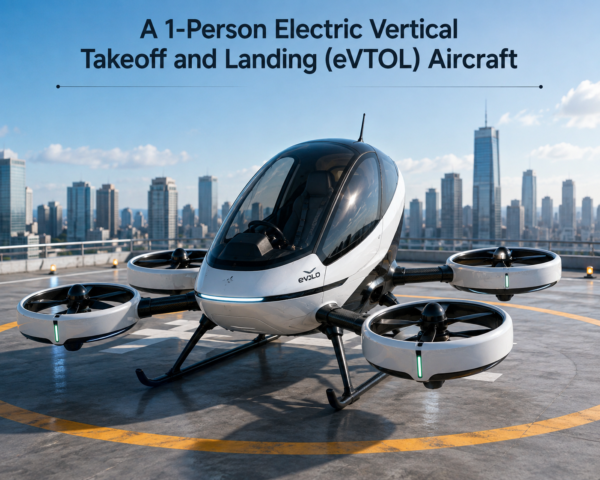
The Rise of the Personal Flying Machine
For generations, the personal flying machine existed primarily as an idea from science fiction. It appeared in films, futuristic illustrations and novels as the ultimate expression of personal freedom: an individual stepping into a compact aircraft, lifting vertically from the ground and traveling directly toward a destination without roads, traffic or airports. For most of aviation history, however, that vision was constrained by the weight of engines, the complexity of mechanical systems, the enormous energy requirements of vertical flight and the difficulty of making aircraft safe enough for ordinary people to operate. Today, those barriers are beginning to change. Advances in electric motors, batteries, lightweight materials, digital flight controls, sensors and autonomous systems have transformed the personal flying machine from a fantasy into a genuine field of aerospace engineering.
The modern personal flying machine is emerging from the much broader revolution in electric vertical takeoff and landing aircraft, commonly known as eVTOLs. These aircraft combine the vertical-access capability of helicopters with electric propulsion and, in many designs, the aerodynamic efficiency of airplanes. NASA’s Advanced Air Mobility program describes an emerging transportation system intended to move people and goods through low-altitude airspace, including passenger transport, cargo delivery and public-service operations. NASA’s research is also intended to provide data that can help the Federal Aviation Administration safely integrate electric air taxis and related aircraft into the national airspace system.
The most important change is that the personal aircraft is becoming smaller, simpler and increasingly electric. Instead of requiring a large turbine engine, complicated transmission and conventional helicopter drivetrain, an electric aircraft can distribute propulsion among several relatively compact motors. Each motor can be controlled electronically, allowing the aircraft’s flight computer to continuously adjust thrust. This distributed propulsion architecture is one of the defining characteristics of many eVTOL concepts and offers possibilities for redundancy, maneuverability and mechanical simplification that were difficult to achieve with earlier generations of personal aircraft.
The idea is particularly powerful when applied to a single person. A conventional airplane must carry wings, landing gear, engine systems, fuel, cockpit equipment and structural components regardless of whether one or several people are aboard. A personal eVTOL can be designed around one occupant from the beginning. Its structure can be extremely compact, its propulsion system can be optimized for the weight of a single human, and its control interface can be simplified through computer-assisted stabilization. This does not eliminate the difficult physics of flight, but it reduces the scale of the problem enough to make personal electric aviation increasingly practical.
One of the clearest examples of this emerging category is the Jetson ONE, developed by Jetson. The company describes it as a single-person electric aerial vehicle using eight electric motors, a lightweight aluminum spaceframe and a high-discharge lithium-ion battery system. Its published specifications include approximately 20 minutes of flight time, a software-limited top speed of 102 km/h, a maximum pilot weight of 95 kilograms and a total mass of approximately 115 kilograms including batteries. Jetson also lists redundant battery propulsion, the ability to remain controllable after losing one motor, hands-free hover and emergency functions, radar-assisted automatic landing and a ballistic parachute. The company says it is currently taking orders for 2028.
The importance of the Jetson ONE is not simply that it is a spectacular machine. Its greater significance is that it demonstrates a fundamentally different philosophy of personal aviation. Instead of asking how to make a traditional airplane smaller, engineers are asking how to redesign the aircraft around electric propulsion, digital control and a single human occupant. The result looks less like a conventional airplane and more like a compact flying platform. In many ways, this is similar to the transformation that occurred in computing, when engineers stopped merely shrinking existing machines and began designing entirely new systems around new technologies.
The rise of personal flying machines is therefore part of a much larger technological transition. Electric propulsion is already transforming automobiles, but aviation presents a far more difficult challenge because aircraft cannot afford to carry heavy energy-storage systems. A car can tolerate a large battery because the road supports the vehicle. An aircraft must carry its battery into the sky while simultaneously generating enough lift to support the entire aircraft and its occupant. Every additional kilogram of battery increases aircraft weight, which increases the energy needed for flight. This creates one of the central engineering problems of personal electric aviation.
Vertical takeoff makes that problem even more difficult. During a conventional airplane’s cruise, its wings generate most of the lift. During vertical takeoff, however, the aircraft has little or no forward speed, meaning its rotors or propellers must generate the necessary upward force directly. Hovering is therefore energetically expensive. A personal aircraft that remains airborne entirely through rotor thrust can be extremely compact and maneuverable, but its flight endurance is likely to remain limited unless battery technology improves substantially.
This explains why there are several competing approaches to personal flying machines. Some designs use multiple rotors arranged around a lightweight frame. These aircraft are relatively straightforward in concept because the rotors provide both lift and control. Other designs use wings so that the aircraft can become much more efficient once it begins moving forward. Still others use tilting propulsion systems that point upward for takeoff and gradually rotate forward for cruise. Each configuration represents a different compromise between simplicity, efficiency, weight, maneuverability and mechanical complexity.
The pure multicopter concept is particularly attractive for personal aviation because it removes the need for a runway. A person could theoretically take off from a compact prepared area, rise vertically, move forward and return to the same location. The aircraft does not need to accelerate to high speed before becoming airborne. That makes it potentially useful in environments where roads are congested or runways are unavailable. But the price of this convenience is energy consumption. The aircraft must continue generating rotor thrust throughout much of its flight, which limits range compared with an efficient winged aircraft.
Winged personal eVTOLs offer another possibility. During takeoff, their electric motors provide vertical thrust. Once the aircraft gains sufficient forward speed, its wings begin producing lift, reducing the amount of power required to remain airborne. This allows a greater proportion of battery energy to be used for forward travel rather than simply holding the aircraft in the air. The difficulty is that wings, rotors and transition systems must all work together safely. The aircraft has to pass through the most challenging phase of its flight when it transitions from vertical lift to forward aerodynamic flight.
The future personal aircraft may therefore look less like the flying cars imagined in twentieth-century science fiction and more like a hybrid between a drone, helicopter and airplane. It could have several electric motors, a compact wing, sophisticated sensors, an enclosed or semi-enclosed cockpit and a powerful onboard computer. The pilot might operate a simple joystick rather than conventional aircraft controls, while software handles much of the stabilization and power distribution. The human would still be responsible for the flight, but the aircraft would increasingly assist with the tasks that traditionally required extensive pilot training.
This transition toward computer-assisted flight is one of the most important aspects of the personal flying-machine revolution. A conventional pilot must understand aircraft attitude, airspeed, altitude, power, navigation and emergency procedures. A highly automated eVTOL can continuously monitor many of these variables itself. Sensors can measure movement and orientation, navigation systems can estimate position, and flight-control software can adjust individual motors many times per second. The result is a machine that can potentially make vertical flight more accessible to people without the extensive manual flying skills traditionally associated with helicopters.
However, automation does not remove the need for safety. It changes the nature of the safety problem. Instead of relying primarily on mechanical reliability and pilot skill, future personal aircraft will depend heavily on software, sensors, electronic systems and redundant computing. An autonomous or highly automated aircraft must be capable of recognizing abnormal conditions and responding correctly. Research into autonomous advanced air mobility increasingly focuses on sensing, perception, planning and control as interconnected components of a future aerial transportation system.
Redundancy is particularly important. A personal aircraft with eight independent motors has an entirely different failure architecture from a helicopter relying on one primary propulsion system. If one motor fails, the flight computer may be able to compensate by increasing thrust from other motors. Jetson specifically advertises the ability of its aircraft to remain controllable following the loss of one motor. The same principle can potentially be extended to batteries, computers, sensors and communication systems. The goal is not to make failure impossible, because no machine can guarantee that, but to prevent an individual component failure from becoming a catastrophic event.
Emergency descent is another fundamental problem. An airplane can generally glide after losing engine power. A conventional helicopter can potentially use autorotation. A multicopter eVTOL does not necessarily have the same aerodynamic options. This is why some personal eVTOL concepts incorporate ballistic parachutes or other emergency descent systems. Jetson, for example, lists a rapidly deployable ballistic parachute among the safety features of the Jetson ONE. Such systems represent an important shift in thinking: the aircraft is not designed only to remain airborne; it is also designed with mechanisms intended to protect the occupant when normal flight is no longer possible.
The personal flying machine will also need to become much more intelligent about its surroundings. A vehicle operating above roads, buildings, trees and people cannot depend exclusively on a pilot looking outside the cockpit. Future aircraft may combine satellite navigation, inertial sensors, cameras, radar and other sensing technologies to construct a real-time understanding of their environment. This could allow them to detect obstacles, monitor terrain and identify suitable emergency landing areas.
The implications become even more significant when multiple personal aircraft begin sharing the same airspace. One flying machine is relatively easy to manage. Ten thousand are not. A future city containing thousands of personal eVTOLs would require a digital equivalent of a road network in the sky. Aircraft would need to know where they could fly, which routes were available, where other aircraft were located and how to avoid collisions. Automated traffic-management systems would likely become essential.
This is one reason the personal flying machine cannot be developed in isolation from the broader Advanced Air Mobility ecosystem. NASA’s vision includes not only aircraft but also the systems needed to integrate low-altitude passenger and cargo transportation into existing airspace. The aircraft is only one piece of the puzzle. Vertiports, charging systems, communications, navigation, traffic management, weather services, emergency procedures and regulations must all develop alongside it.
Regulation represents one of the most important milestones in this transition. Aviation authorities have historically treated aircraft very differently from road vehicles because failures can have consequences far beyond the occupants. A personal flying machine therefore cannot simply be sold like an electric scooter and operated anywhere its owner chooses. Its classification, operating environment, pilot requirements and airworthiness standards depend on the jurisdiction and aircraft design.
In the United States, the Federal Aviation Administration made a significant regulatory step in October 2024 when it finalized a framework for powered-lift aircraft. The FAA described powered lift as a new category with characteristics of both airplanes and helicopters and established rules concerning pilot qualifications, training and operations. The agency specifically identified applications including urban passenger transportation, short-haul operations, air ambulance services, cargo transportation and potential service to smaller communities.
This development is important because the emergence of a new aircraft category requires more than technological innovation. It requires an institutional framework that tells manufacturers what standards they must meet and tells pilots how aircraft can legally be operated. Certification creates the bridge between experimental machines and transportation systems that can be trusted by the public. The FAA and European Union Aviation Safety Agency have also been working toward greater alignment in eVTOL certification policy, another indication that regulators recognize the international nature of this emerging aviation sector.
The personal flying machine also raises an important question about who should be allowed to operate one. If an aircraft is extremely automated, should the owner need the same level of training as a helicopter pilot? If it is manually controlled, should the requirements be even more demanding? Regulators will have to balance accessibility with safety. The more the aircraft depends on human control, the greater the need for pilot training. The more it depends on automation, the greater the need for highly reliable software and certification.
The distinction between a personal aircraft and a flying taxi is also becoming increasingly important. A personal flying machine is intended to provide individual ownership and control. An air taxi, by contrast, is operated as part of a transportation service. Large eVTOL companies are primarily pursuing the latter model, with aircraft designed to carry several passengers and operate repeatedly along commercial routes. Personal eVTOL manufacturers are exploring a different market: individuals who want to own and operate compact aircraft for recreation, personal transportation or specialized missions.
This distinction could shape the future of the industry. Commercial air taxis may reach practical operation sooner in some markets because professional pilots, centralized maintenance and controlled vertiports can simplify safety management. A privately owned personal aircraft is much harder to regulate because thousands of individual operators could use them in different environments. That makes personal aviation potentially more disruptive, but also potentially more difficult to integrate safely into society.
The economics of personal flying machines are another major barrier. Early examples remain expensive compared with conventional consumer transportation. The aircraft itself is only part of the cost. Owners must consider charging infrastructure, maintenance, training, insurance, storage and regulatory requirements. A personal flying machine may therefore initially resemble the market for private aircraft rather than automobiles: attractive to enthusiasts, wealthy early adopters, businesses and specialized users before mass production and technological maturity potentially bring costs down.
Manufacturing scale could change this dramatically. Electric motors can be produced in large quantities. Battery systems can become standardized. Lightweight structures can be manufactured with increasingly automated processes. Flight-control hardware can be reused across different aircraft models. As production volumes increase, the cost of individual components could fall. The larger the market becomes, the more manufacturers can justify investing in dedicated production facilities and automated manufacturing.
But affordability depends heavily on batteries. Battery packs remain one of the most expensive and weight-sensitive components of an electric aircraft. A major breakthrough in energy density would have consequences far beyond simply extending flight time. A lighter battery could allow the aircraft to carry a larger safety reserve, stronger structure, more capable avionics or a heavier pilot without increasing total aircraft mass. Conversely, if battery improvements remain slow, personal eVTOLs may continue to be restricted to relatively short-duration flights.
The present limitations are visible in the specifications of existing personal aircraft. Jetson’s approximately 20-minute flight time demonstrates that current technology can support personal vertical flight, but it also illustrates why the category has not yet become a replacement for automobiles. A twenty-minute flight can be extraordinarily useful for recreation or short-distance transportation, but it leaves little room for long journeys, weather diversions or extensive cruising. For personal aircraft to become everyday transportation, endurance and energy reserves will likely have to improve substantially.
The challenge is not simply increasing battery capacity. More battery means more weight. More weight requires more lift. More lift requires more energy. The engineers therefore have to improve the entire system simultaneously. Higher-energy batteries help, but so do lighter structures, more efficient motors, better propellers, improved aerodynamics, intelligent flight paths and advanced energy management. The future personal flying machine will probably be the result of many incremental improvements rather than one miraculous technological breakthrough.
Materials science will play an important role. Carbon-fiber composites, advanced aluminum alloys and other lightweight materials allow engineers to construct strong structures without adding unnecessary mass. Every kilogram saved from the frame can potentially be used for additional battery energy or payload. Yet lightweight construction cannot come at the expense of crashworthiness. The aircraft must protect the occupant during hard landings and accidents, creating a tension between minimizing mass and maximizing structural protection.
NASA has already investigated the crashworthiness of eVTOL designs. In 2022, researchers performed a full-scale crash test of a lift-plus-cruise eVTOL concept to study how impact forces would affect occupants. Such research demonstrates that future air mobility is not being evaluated solely on whether aircraft can fly. Engineers are also studying what happens when things go wrong.
Noise is another factor that could determine whether personal flying machines become socially acceptable. Electric propulsion does not mean silent propulsion. Rotors and propellers generate sound as they accelerate air, particularly during takeoff and landing. The advantage of electric propulsion is that it gives engineers much more flexibility in controlling motor speed and rotor configuration. NASA has therefore devoted significant research to understanding and reducing the noise generated by advanced air-mobility aircraft.
The ideal personal aircraft of the future may therefore be designed around a principle that sounds simple but is technically demanding: maximum usefulness with minimum disturbance. It should be quiet enough that communities tolerate it, efficient enough that batteries provide practical range, automated enough that ordinary people can operate it safely, robust enough to withstand failures and affordable enough that it is not merely a technological curiosity.
Rural areas may become particularly important proving grounds. A personal flying machine does not need to solve the same problems in an open rural environment that it faces in a dense city. There may be fewer obstacles, less air traffic and more space for emergency landing. A farmer, surveyor, infrastructure inspector or emergency worker could potentially use a compact aircraft to travel rapidly across terrain that would otherwise require a long road journey.
Remote medical access could become another significant application. A small vertical aircraft could potentially reach isolated areas much faster than a road vehicle, particularly where terrain makes conventional transportation difficult. Search-and-rescue teams could use compact aircraft to reach mountains, forests or disaster zones. Infrastructure companies could inspect power lines, pipelines, bridges and remote facilities. In these applications, the value of the aircraft would not necessarily come from replacing cars but from reaching places that cars cannot easily reach.
The personal flying machine may also become a powerful recreational technology. Just as motorcycles provide a different experience from automobiles and private airplanes provide a different experience from commercial aviation, personal eVTOLs could create an entirely new category of recreational flight. Their vertical takeoff capability could make them attractive to pilots who want the freedom of flight without the runway requirements of conventional airplanes.
Yet recreational use also raises questions about risk. The easier an aircraft becomes to operate, the more people may be tempted to use it without fully understanding weather, airspace or emergency procedures. This creates an important paradox. Better automation can make aviation safer, but greater accessibility can also expand the population of inexperienced operators. Regulation and training will therefore need to evolve alongside technology.
One of the most fascinating possibilities is that the personal flying machine could eventually become partially autonomous. Instead of manually flying from point A to point B, an owner might enter a destination, and the aircraft would calculate an approved route, monitor weather, avoid restricted airspace and manage the flight. The human could remain responsible for the journey while the aircraft handles many of the complex control tasks.
A fully autonomous future is more difficult. Research into autonomous advanced air mobility emphasizes that safe autonomy involves much more than automatic stabilization. The aircraft must perceive its environment, plan routes, coordinate with other vehicles and respond to unexpected situations while satisfying strict aviation safety requirements. The challenge becomes even greater when multiple autonomous aircraft share the same airspace.
Artificial intelligence could eventually make these systems more capable. An AI-assisted aircraft could monitor battery degradation, identify unusual motor behavior, predict maintenance requirements and optimize flight paths according to energy consumption. It could potentially learn how different weather patterns affect the aircraft and adjust its operating strategy accordingly. But AI in aviation will need to be constrained by rigorous safety engineering rather than treated as an unrestricted decision-maker.
The infrastructure around personal aircraft could eventually become as important as the aircraft themselves. Imagine a future neighborhood with a small landing platform, an automated charging station and a digital connection to the local airspace network. A person could arrive at the platform, enter a destination, receive clearance and take off. The aircraft would rise above the neighborhood, join a designated route and eventually descend at another prepared landing site.
Such a system would fundamentally alter the relationship between cities and transportation. Today’s cities are organized primarily in two dimensions. Roads, railways and pedestrian routes determine how people move horizontally across the ground. Personal aviation introduces a third dimension. Buildings, rooftops and open spaces could become nodes in a three-dimensional transportation network.
But that network would need strict boundaries. Not every rooftop can become an airport. Not every open field should become a landing site. Noise, safety zones, property rights, emergency access and airspace restrictions would have to be considered. The future of personal aviation will therefore involve not just aerospace engineering but urban planning, law, insurance, public policy and community participation.
The environmental argument also requires careful examination. Electric aircraft produce no direct exhaust emissions during flight, but electricity must still be generated somewhere, and batteries require energy and raw materials to manufacture. The environmental benefit depends on the energy source, battery production, aircraft utilization and the transportation mode being replaced. A personal eVTOL replacing a helicopter could have a very different environmental profile from one replacing a bicycle, train or electric car.
The greatest environmental opportunity may come from replacing inefficient short-distance helicopter operations. Helicopters are extraordinarily useful but can be expensive, noisy and fuel-intensive. Electric propulsion offers the possibility of performing some short-distance vertical-flight missions with lower operational emissions and potentially lower operating costs. Whether eVTOL aircraft achieve a meaningful environmental advantage at scale will ultimately depend on how they are used and how clean the electricity powering them becomes.
The commercial aviation industry is already moving toward this broader electric-air-mobility future. NASA began testing Joby’s all-electric eVTOL aircraft in 2021 as part of its Advanced Air Mobility National Campaign, examining how such aircraft could eventually operate within the national transportation system. Current industry development is increasingly focused on certification, production and actual operational deployment rather than simply demonstrating that eVTOL technology can fly.
This shift from demonstration to commercialization is crucial. For years, the flying-car concept was dominated by spectacular prototypes and futuristic promises. The next phase is much less glamorous but far more important. Manufacturers must prove that aircraft can be produced consistently, maintained economically, certified by regulators and operated safely day after day. A prototype can attract attention with one successful flight. A transportation system requires millions of successful flights.
The rise of the personal flying machine will therefore probably happen gradually rather than suddenly. The first stage may consist of recreational aircraft and specialized applications. The next stage could involve commercial air taxis operating on fixed routes. As batteries improve, autonomous systems mature and infrastructure expands, more flexible personal transportation may become possible. Eventually, if the economics and regulations allow it, personal aircraft could become a recognizable part of everyday transportation.
There is also the possibility that the most important future personal flying machines will not be owned at all. Instead, people may summon them when needed through digital platforms. This would resemble today’s ride-sharing systems, except that the vehicle would travel through the air. Such a model could reduce the need for individual maintenance and storage while allowing aircraft to operate continuously throughout the day. A fleet operator could maintain the vehicles professionally and optimize their utilization.
Private ownership would nevertheless remain attractive for some users. An aircraft that can be stored at home and launched when needed offers a degree of freedom that a shared air-taxi network cannot provide. It could become analogous to owning a motorcycle, recreational aircraft or high-performance vehicle. The question is whether regulations will eventually allow sufficiently broad personal operation.
The personal flying machine could also become a symbol of technological independence. For more than a century, the automobile gave individuals freedom from fixed transportation schedules and routes. The personal aircraft could extend that freedom vertically. Instead of being restricted to roads, individuals could potentially travel directly across geographical obstacles. Mountains, rivers and congested highways would become less important barriers.
Yet freedom in the air must always coexist with collective safety. Aviation is a shared environment. The more people use it, the more important coordination becomes. A future in which every individual can freely fly anywhere without restrictions is unlikely to be practical. The realistic future is more likely to involve intelligent digital boundaries, designated routes, automated traffic coordination and carefully controlled landing areas.
This may ultimately produce a very different experience from the flying cars imagined by science fiction. Instead of people randomly flying above cities, the future could resemble an invisible three-dimensional transportation grid. Aircraft would automatically select routes, maintain separation, avoid restricted areas and coordinate with vertiports. The passenger might experience the journey as effortless, even though an enormous technological infrastructure operates behind the scenes.
The personal flying machine could also become a stepping stone toward larger societal changes. Technologies developed for small personal aircraft can feed into larger eVTOL air taxis, cargo drones, emergency aircraft and regional electric aviation. Improvements in batteries, electric motors, flight computers, sensors and autonomy benefit multiple sectors simultaneously. The one-person aircraft is therefore not merely a niche product; it can serve as a testbed for technologies that could eventually reshape aviation as a whole.
The most difficult question is whether batteries will improve quickly enough. Current personal eVTOLs demonstrate that short-duration electric vertical flight is possible, but longer-range personal aviation remains constrained by energy density. Enthusiast discussions around current personal eVTOLs frequently identify this limitation: small aircraft can provide impressive short flights, while larger eVTOL concepts designed for longer-range commercial transportation require much greater battery capacity and remain subject to certification and infrastructure challenges.
A breakthrough in energy storage would therefore have enormous consequences. Imagine a battery that provides twice the usable energy for the same mass while maintaining aviation-grade safety and durability. A personal eVTOL could potentially double its endurance without doubling its weight. That could transform the machine from a short recreational flight vehicle into a genuine transportation tool.
But even without such a breakthrough, the technology is already forcing engineers and regulators to rethink what an aircraft can be. Electric motors make distributed propulsion practical. Computers make sophisticated stabilization accessible. Sensors make automated assistance possible. Lightweight materials reduce structural weight. Batteries eliminate the need for fossil fuel combustion during flight. Together, these technologies have created a new design space that did not previously exist.
The rise of the personal flying machine is therefore not about one company, one aircraft or one spectacular prototype. It is the result of several technological revolutions arriving at the same time. Electric propulsion provides the motors. Advanced batteries provide the energy. Lightweight materials provide the structure. Software provides the control. Sensors provide environmental awareness. Artificial intelligence provides increasingly sophisticated decision-making. Digital communications provide connectivity. New regulations provide the legal framework.
The remaining challenge is to make all of those components work together reliably and economically. Aviation is unforgiving. A system can be technically impressive and still fail commercially if it is too expensive, too noisy, too difficult to maintain or too restricted by regulation. The personal flying machine must therefore evolve from an engineering achievement into a complete transportation product.
If that transformation succeeds, the consequences could be extraordinary. A future traveler might no longer think of flight as something that begins at an airport. A person could potentially walk to a neighborhood vertiport, enter a compact electric aircraft and travel directly to another part of the region. A rural resident could reach a distant hospital more quickly. An emergency worker could fly over a blocked road. A technician could inspect remote infrastructure. A recreational pilot could simply rise vertically and experience the freedom of flight.
The most profound change, however, would be psychological. For thousands of years, human beings have looked at the sky as a place occupied by birds, clouds and distant aircraft. Personal flying machines could transform it into another transportation environment. The sky would no longer be merely something we look at or pass through occasionally; it could become an everyday extension of the transportation network.
That future is not guaranteed. Battery limitations, safety requirements, certification, noise, infrastructure, economics, weather and public acceptance remain formidable obstacles. The FAA’s recent powered-lift framework demonstrates that regulators are beginning to create pathways for this new category, but certification and large-scale integration remain demanding processes.
Nevertheless, the historical significance of the personal flying machine may already be emerging. The question has shifted from whether an individual can be lifted into the air by a compact electric machine to how such machines can be made safe, useful, affordable and socially acceptable. That is a much more practical question—and one that engineers, governments and entrepreneurs are now actively attempting to answer.
The dream of personal flight is therefore entering a new chapter. The flying machine of the future may not be the enormous, road-capable automobile with wings that science fiction once promised. It may be something smaller, quieter and more technologically sophisticated: an electric aircraft that rises vertically, stabilizes itself with software, distributes propulsion among multiple motors, navigates through digitally managed airspace and carries one or a few people directly toward their destination.
If the technological pieces continue to mature, the personal flying machine could become one of the most remarkable transportation developments of the twenty-first century. It would represent more than the electrification of aviation. It would represent the decentralization of flight itself—the moment when the ability to move through the sky begins to shift from large airports and specialized aircraft toward compact machines designed around individual human mobility. The road created the age of personal ground transportation. Electric vertical flight may eventually create the age of personal aerial transportation.