The One-Person Flying Car: How Personal eVTOL Aircraft Could Transform Human Mobility
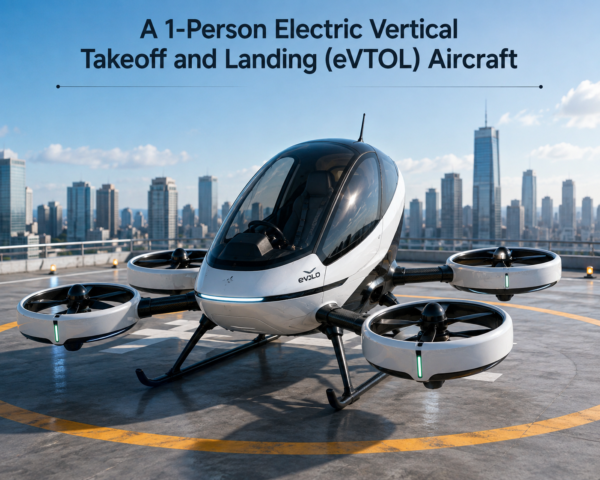
The idea of a person stepping into a compact aircraft, lifting vertically from the ground, and flying directly toward a destination has moved from science fiction into the realm of serious aerospace engineering. The one-person flying car represents perhaps the most intimate expression of the emerging electric vertical takeoff and landing, or eVTOL, revolution. Instead of carrying several passengers like the air taxis being developed by major aerospace companies, a personal eVTOL is designed around a single human occupant. It is smaller, more mechanically distributed, potentially simpler to operate, and potentially capable of giving an individual something that conventional transportation has never offered: personal access to three-dimensional mobility. The technology is still developing, but aircraft such as Pivotal’s single-seat Helix and Jetson’s one-person Jetson ONE demonstrate that personal electric vertical flight is no longer merely a theoretical concept.
The phrase “flying car,” however, can be misleading. A one-person eVTOL is generally closer to a miniature aircraft than to a road automobile that happens to have wings. The fundamental engineering problem is not simply making a vehicle fly; it is making a compact aircraft generate enough vertical thrust to lift itself and its occupant, maintain stability, transition safely between flight modes where applicable, conserve enough energy to travel a useful distance, and return to the ground with adequate reserves. A conventional car can stop almost anywhere, while an aircraft cannot. Every flight requires consideration of takeoff, weather, obstacles, airspace, battery energy, emergency procedures and landing conditions. This difference explains why the personal flying machine should be understood primarily as an aircraft rather than as the next generation of automobile.
The most important feature of the eVTOL concept is vertical takeoff and landing. A conventional airplane requires a runway because its wings generate most of its lift only after the aircraft reaches sufficient forward speed. A helicopter solves this problem with a large rotor capable of producing lift while the aircraft is stationary relative to the ground. An eVTOL takes another route. It distributes propulsion across multiple electric motors and propellers or rotors, allowing the aircraft to generate vertical thrust without a conventional runway. European aviation regulators describe VTOL aircraft as a new category requiring dedicated certification approaches, while the FAA defines powered-lift aircraft as aircraft capable of vertical takeoff and landing that can transition into airplane-like cruise flight.
Electric propulsion is particularly attractive for this architecture because electric motors are compact, responsive and mechanically comparatively simple. Instead of relying on one large engine and complicated mechanical transmission systems, designers can distribute several motors around the airframe. This creates an architecture in which individual propulsion units can be controlled independently. EASA notes that distributed propulsion, when properly implemented, can share critical functions among multiple components and potentially improve safety. Modern eVTOL designs demonstrate this philosophy in practice: Joby’s aircraft, for example, uses six electric motors and six propellers along with redundant flight-computer architecture.
For a one-person aircraft, distributed propulsion becomes especially interesting because the entire vehicle can be designed around the occupant. There is no need for a large cabin, multiple passenger seats, baggage compartments or the structural mass required by a conventional aircraft designed to transport many people. The result can be an extremely compact machine in which the pilot effectively sits at the center of the propulsion and control system. This creates a completely different design philosophy from that of an airliner or even an air taxi. Rather than building an aircraft and then placing people inside it, engineers can potentially build the aircraft around one person’s mass, posture, visibility, controls and emergency requirements.
That simplicity does not mean the aircraft itself is simple. Vertical flight is energetically demanding because the propulsion system must continuously generate enough thrust to counter gravity during hovering and takeoff. A personal eVTOL therefore lives under a difficult engineering compromise: the aircraft must carry enough battery energy to perform the mission, but every additional kilogram of battery increases the amount of lift required, which in turn requires more energy. This creates a circular relationship between mass, battery capacity, power, flight time and range. The challenge becomes even more severe because aviation cannot treat a battery the same way a road vehicle treats its fuel reserve. An aircraft must retain sufficient energy for unexpected conditions, diversions and emergency landing scenarios.
Battery technology is therefore one of the central factors determining how useful personal eVTOL aircraft can become. NASA research has identified energy density, power, safety, packaging and scalability as critical requirements for electric aviation batteries, and has emphasized that current lithium-ion technology faces significant limitations when these requirements are considered together. Other NASA research has similarly concluded that eVTOL aircraft require battery performance beyond what conventional automotive applications demand. The problem is not simply creating a battery with more capacity. An aviation battery must also deliver very high power when required, remain thermally stable, survive repeated demanding cycles, protect occupants during accidents and maintain predictable performance as it ages.
This explains why many early personal eVTOL concepts have relatively modest flight times compared with what people might imagine when they hear the words “flying car.” The Jetson ONE, for example, lists approximately 20 minutes of flight time and a software-limited top speed of 102 km/h, while Pivotal’s Helix lists approximately 20 minutes of electric endurance and a 20-mile electric range. These numbers reveal something important about the first generation of personal eVTOLs: their initial purpose may not be to replace automobiles for long-distance travel. They are better understood as short-range personal aircraft designed for specialized recreational, commuting or point-to-point missions where the ability to bypass roads has greater value than maximum range.
The distinction between a personal eVTOL and a commercial air taxi is also crucial. The most prominent eVTOL companies are generally developing aircraft designed to carry a pilot and multiple passengers. Joby, for instance, describes its current aircraft as carrying a pilot plus four passengers, with a target speed of up to 200 mph. Such aircraft are intended to become part of an organized transportation network, potentially operating from vertiports and following regulated routes. A one-person aircraft belongs to a different category of mobility. Its greatest promise is individual ownership: the possibility that a person could eventually keep an aircraft at home, transport it to a suitable launch location, and use it for short flights without depending entirely on an airline or air-taxi operator.
One of the most fascinating developments is the appearance of personal aircraft designed specifically around simplified operation. Pivotal’s Helix, for example, is described by its manufacturer as a single-seat personal aerial vehicle and is classified in the United States under Part 103 ultralight rules. The company lists features including a triple-redundant flight-control system, radar-guided autoland and a ballistic parachute. Jetson’s ONE similarly incorporates multiple safety concepts, including redundant battery propulsion, the ability to remain controllable after loss of one motor, automated hover and emergency functions, radar-assisted landing and a ballistic parachute. These features illustrate an important principle of personal electric flight: because the aircraft is small, designers cannot simply rely on conventional aviation architecture. They must integrate redundancy, automation and emergency protection into an exceptionally compact package.
Automation could ultimately be one of the technologies that makes personal eVTOLs accessible to ordinary people. Flying a helicopter or airplane requires considerable training because the pilot must continuously manage the aircraft’s attitude, speed, altitude, navigation and engine or rotor systems. A future personal eVTOL could potentially automate many of these tasks. Flight computers can continuously monitor motor performance, battery condition, aircraft attitude, altitude and navigation. Sensors can assist with obstacle awareness and landing. Automated systems can potentially stabilize the aircraft even when the occupant makes an imperfect control input. Yet automation does not eliminate the fundamental requirement for aviation safety. A computer can fail, sensors can become unreliable, communications can be interrupted and software can contain vulnerabilities. Research into advanced air mobility has already identified cybersecurity issues involving navigation, communications, aircraft systems and connected infrastructure as an emerging concern.
The physical design of the aircraft will also determine how successfully the concept can transition from demonstration technology into everyday transportation. A conventional helicopter uses a large rotor because a large rotor can produce the required lift efficiently at relatively low disk loading. A personal eVTOL with many small propellers takes a different approach. Smaller propulsion units can be distributed around the aircraft, potentially improving packaging, control authority and redundancy, but designers must carefully manage aerodynamic efficiency, noise, structural loads and energy consumption. The resulting aircraft is therefore a compromise between the efficiency of large lifting surfaces and the flexibility of distributed electric propulsion.
Noise is another area where electric propulsion could change the experience of vertical flight. Helicopters are notorious for their distinctive rotor noise, particularly in urban environments. Electric motors themselves are comparatively quiet, although propellers remain an important source of aerodynamic noise. The design of rotor diameter, blade geometry, rotational speed and flight profile therefore becomes critical. Current commercial eVTOL developers are explicitly working on acoustic reduction; Joby, for example, reports a cruise sound level of 45 dBA for its aircraft, while Archer emphasizes the use of smaller rotors and electric propulsion as part of its approach to reducing noise. Personal aircraft may eventually benefit from the same principles, although the actual acoustic impact of any individual design must be established through testing rather than assumed simply because the aircraft is electric.
The environmental argument for personal eVTOLs is similarly more complicated than the phrase “electric flying car” might suggest. An electric aircraft produces no direct exhaust emissions during flight, but that does not mean that its entire environmental footprint is zero. Battery manufacturing, aircraft production, electricity generation, replacement components, maintenance and eventual battery recycling all contribute to the total lifecycle impact. EASA specifically cautions that the environmental footprint of VTOL aircraft needs to be considered across the entire lifecycle, including the source of the energy used. A small electric aircraft powered by low-carbon electricity could have a very different environmental profile from one charged using electricity generated predominantly from fossil fuels.
Perhaps the greatest conceptual challenge is the phrase “car.” A car is useful because the world is designed around cars. Roads connect neighborhoods, parking spaces exist almost everywhere, fuel and charging infrastructure are widespread, and drivers can usually pull over when something goes wrong. The sky does not work this way. A personal aircraft requires appropriate takeoff and landing areas, sufficient clearance from obstacles, compliance with airspace restrictions, weather awareness and a safe place to land. The aircraft may be small enough to fit on a trailer or inside a garage, but its operational environment is considerably more complicated than that of a car. The future of personal eVTOLs will therefore depend not only on better aircraft but also on the creation of an ecosystem in which those aircraft can be used safely.
Regulation is already evolving to accommodate this new category. In October 2024, the FAA finalized rules covering powered-lift pilot certification, training and operating requirements, creating a framework for aircraft that combine characteristics of airplanes and helicopters. The FAA has continued working on the integration of eVTOL technology, and in July 2026 it announced flight testing involving BETA Technologies and United Therapeutics for medical-organ transport missions under its eVTOL Integration Pilot Program. Meanwhile, EASA has developed dedicated VTOL certification specifications and has continued updating requirements for electric and hybrid propulsion and other non-conventional aircraft. This regulatory progress is significant because an aircraft cannot become a mainstream transportation product simply by demonstrating that it can fly.
The regulatory environment also highlights an important distinction between a small personal aircraft and a commercially operated passenger aircraft. Some personal eVTOLs may fit into relatively light recreational or ultralight categories in particular jurisdictions, while aircraft intended to carry passengers commercially face much more demanding certification and operational requirements. In the United States, the FAA’s light-sport framework now explicitly includes accepted consensus standards for powered-lift and multicopter aircraft, illustrating how aviation regulation is beginning to recognize these new configurations. In Europe, EASA’s framework distinguishes operations according to their risk and environment, with more demanding certification requirements associated with operations over congested areas. Consequently, the legal status of a personal flying machine cannot be generalized globally; where and how it can be flown is just as important as its engineering specifications.
Safety will ultimately determine whether the personal flying car becomes a genuine transportation revolution or remains a fascinating niche technology. A road vehicle can often survive a mechanical failure by stopping at the roadside. An aircraft has much less room for failure. This is why redundancy is so important in eVTOL engineering. Multiple motors can potentially provide continued control after the failure of one propulsion unit, while independent battery systems and flight computers can reduce the consequences of individual component failures. Parachutes, automated landing systems and emergency flight modes can provide additional layers of protection. These systems do not make an aircraft inherently safe, but they can create multiple barriers between a component failure and a catastrophic outcome.
The architecture of a one-person aircraft can actually provide an interesting safety advantage in one respect: the aircraft does not have to carry a large number of people. A failure involving a single personal vehicle affects primarily its occupant, whereas a commercial air taxi carrying several passengers creates a different risk profile and certification burden. This does not make personal aircraft acceptable at lower safety standards, particularly when they operate over populated areas, but it may allow some early personal concepts to develop within different regulatory categories. The central challenge is ensuring that a personal aircraft remains safe not only for its occupant but also for everyone beneath and around it.
The question of whether these machines will truly become “cars” therefore depends on more than technological feasibility. A flying vehicle could technically be capable of vertical takeoff and landing and still fail as a mass-market transportation system because it is too expensive, too difficult to maintain, too limited in range, too difficult to operate, or too restricted by regulation. The recent history of the eVTOL industry demonstrates why this distinction matters. The aerospace sector has made significant progress in prototypes, flight testing, certification frameworks and infrastructure, but scaling an aircraft from an engineering demonstration into a reliable mass-produced product remains an enormous challenge. Current developments are increasingly focused not merely on whether eVTOLs can fly, but on certification, production, maintenance, charging infrastructure and operational integration.
Infrastructure may become one of the least visible but most decisive parts of the revolution. If every personal eVTOL requires specialized landing pads, high-power charging equipment and dedicated maintenance facilities, widespread ownership could become difficult. The ideal future would require a network of safe landing locations integrated into homes, businesses, transportation hubs and communities. Charging would need to be fast enough for practical use without compromising battery life or safety. Maintenance would need to be predictable and affordable. Eventually, airspace management would need to accommodate potentially large numbers of small aircraft without turning the sky into an uncontrolled maze.
This is where artificial intelligence and autonomous flight systems could become especially important. A future urban environment containing thousands of personal aircraft could not depend entirely on every occupant manually navigating around every other aircraft. Digital traffic management, automated routing, collision avoidance and dynamic airspace management could become essential. Aircraft might continuously exchange information about position, altitude, speed and intended trajectory. Automated systems could determine safer routes around weather or congestion and potentially coordinate landings at busy sites. Such a future would transform airspace from a relatively sparse environment into a highly computerized transportation network.
Yet the most realistic near-term future may be much less dramatic than the science-fiction vision. Instead of millions of people immediately replacing their cars with personal aircraft, early adoption is likely to occur in carefully controlled environments and specialized use cases. Recreational flying, remote-area transportation, emergency response, medical logistics, infrastructure inspection and short-distance mobility may provide more practical early markets. The FAA’s 2026 testing of eVTOL medical transport capabilities illustrates how the technology is already being explored for missions where the benefits of vertical flight can justify the complexity.
Personal eVTOLs could eventually become particularly valuable in places where roads are congested, terrain is difficult or conventional transportation infrastructure is expensive to build. A mountain community, island region, remote industrial site or geographically fragmented city could benefit from direct aerial mobility in ways that a conventional urban environment may not. The ability to travel directly from one point to another without following the road network is the fundamental advantage. In that sense, the flying car is not really about making automobiles fly; it is about eliminating the assumption that transportation must remain two-dimensional.
There is also a profound psychological dimension to the concept. For more than a century, personal transportation has meant controlling a vehicle on the ground. The personal eVTOL changes the relationship between human beings and physical space. Instead of being constrained by roads, bridges and terrain, the traveler could potentially move above them. A journey that once required following a winding road around a mountain could become a direct flight across it. A crowded city street would no longer necessarily determine the route. Distance could increasingly be measured not by the length of roads but by the efficiency and safety of an aerial trajectory.
At the same time, the democratization of flight raises difficult social questions. If personal aircraft become affordable, who will be allowed to fly them, where will they be allowed to fly, and how will communities respond to aircraft operating above homes and neighborhoods? Noise, privacy, safety, visual pollution, emergency landing zones and unequal access could become significant political issues. The sky has historically been relatively open compared with the road network, but a future filled with personal aircraft would require much more sophisticated rules governing who can use that space and under what conditions.
The economics will ultimately determine whether the one-person flying car becomes a transportation revolution or remains a luxury product. An aircraft is more demanding to manufacture and maintain than a road vehicle. Aviation-grade components require extensive testing, certification and quality control. Batteries have finite life cycles. Motors, propellers, flight computers and sensors all require inspection and maintenance. Insurance, registration, pilot training or eligibility requirements may add further costs depending on jurisdiction and aircraft category. Even if mass production reduces the purchase price, the total cost of ownership could remain substantially higher than that of a conventional electric car.
There is nevertheless a powerful economic argument in favor of simplicity. A one-person aircraft does not need to carry hundreds or thousands of kilograms of passengers, fuel and cabin equipment. Electric propulsion eliminates many traditional mechanical systems, while software can increasingly handle flight-control functions that once required complex mechanical mechanisms. Manufacturing techniques such as advanced composites, automated assembly and improved electric motors could further reduce weight and production costs. If battery technology continues to improve while electric propulsion becomes cheaper and more reliable, the personal eVTOL could eventually move from an experimental aerospace product toward a recognizable consumer technology.
The most important breakthrough, however, may not be a spectacular increase in top speed. It may be the gradual improvement of energy density, reliability and automation. A personal aircraft that flies for twenty minutes but is extremely reliable, easy to operate and inexpensive to recharge could be more transformative than an aircraft capable of flying at hundreds of kilometers per hour but requiring extensive preparation. The history of transportation suggests that convenience often matters more than raw performance. The successful personal flying machine will likely be the one that makes flight feel ordinary rather than heroic.
The one-person eVTOL therefore represents something larger than a futuristic vehicle. It is a convergence point for electric motors, advanced batteries, lightweight structures, computer-controlled flight, sensors, artificial intelligence, robotics, aviation regulation and new approaches to transportation infrastructure. None of these technologies alone is sufficient. The aircraft must work as an integrated system. A powerful motor is useless without an adequate battery. A sophisticated battery is useless without thermal and safety systems. An autonomous flight computer is useless without reliable sensors. A capable aircraft is useless without legal access to airspace and suitable places to take off and land.
As of 2026, that future is beginning to take recognizable form, but it has not yet become everyday transportation. Personal aircraft such as the Jetson ONE and Pivotal Helix show that single-seat electric VTOL flight can be engineered into compact machines with meaningful safety and control systems. Meanwhile, the broader eVTOL industry is moving through increasingly mature certification, testing and infrastructure programs. The critical question is no longer simply whether an electric aircraft can rise vertically from the ground. It clearly can. The harder question is whether engineers, regulators, manufacturers and communities can create an ecosystem in which thousands or eventually millions of people can do it safely, affordably and responsibly.
The ultimate vision of the one-person flying car is consequently not a machine that merely flies. It is a new form of personal mobility in which the boundary between automobile, aircraft and intelligent robot begins to disappear. The occupant would no longer simply drive a machine; they would command a highly automated aerial platform capable of sensing its environment, managing propulsion, navigating the sky and responding to emergencies. Roads would remain essential, but they would no longer be the only infrastructure defining human movement.
Perhaps the most remarkable aspect of this emerging technology is that the future flying car does not necessarily need to resemble the flying cars imagined by earlier generations. It may not have four wheels, a conventional cabin or retractable wings. It may look more like a lightweight robotic aircraft, surrounded by multiple electric propellers and controlled through a simple interface. That difference is significant. The future of personal flight may arrive not by making the automobile fly, but by abandoning the automobile’s architecture altogether.
The one-person eVTOL is therefore best understood as an experiment in redefining personal freedom of movement. Its promise is extraordinary: vertical takeoff from compact spaces, direct point-to-point travel, electric propulsion, potentially low noise, intelligent flight assistance and freedom from the geometry of roads. Its obstacles are equally extraordinary: battery limitations, certification, safety, weather, airspace management, infrastructure, cost, public acceptance and the complexity of operating aircraft in populated environments. The technology stands precisely at that fascinating boundary where engineering possibility meets practical reality.
If these challenges can be solved, the personal flying machine could eventually become one of the most significant transportation technologies of the twenty-first century. It would not simply make journeys faster. It would change the map itself. Mountains, rivers, traffic jams and winding roads would become less dominant constraints on movement. The city could acquire a new layer of transportation above its streets, while rural and remote communities could gain entirely new forms of connectivity. The dream of personal flight would finally become something more tangible than science fiction: not humanity escaping the ground completely, but humanity gaining another dimension in which to travel.