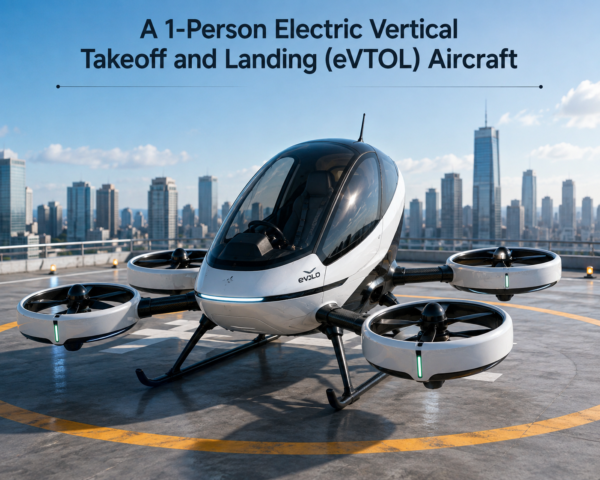
Drones Are Turning Into Personal Flying Machines
For years, the word “drone” meant something small, unmanned and remotely controlled. It meant a camera hovering over a landscape, a quadcopter inspecting a building, a military aircraft operating from a distant control station or a delivery vehicle carrying a small package. The person remained safely on the ground while the machine occupied the sky. That boundary is now beginning to disappear. The same technologies that transformed drones into remarkably capable flying robots are being adapted into aircraft large enough to carry human beings. In effect, the drone is beginning to evolve into something much more ambitious: a personal flying machine.
This transformation is one of the most fascinating developments in modern aviation because it does not require humanity to invent an entirely new form of flight. Instead, engineers are taking technologies that already made drones inexpensive, stable and highly automated and scaling them upward. Electric motors, lightweight batteries, flight computers, inertial sensors, satellite navigation, cameras, radar, autonomous navigation and distributed propulsion are being combined into aircraft capable of carrying people. NASA’s Advanced Air Mobility program explicitly connects these developments, describing a future transportation system involving low-altitude passenger transport, cargo delivery and public-service operations while researching the integration of electric air taxis and drones into the national airspace.
The difference between a large drone and a personal flying machine can sometimes be surprisingly small. A multicopter drone may have four, six or eight motors, each controlled electronically. A human-carrying eVTOL can use essentially the same fundamental principle, except that the motors, batteries, structure and control systems are scaled for the mass of a person. Once a human sits inside the vehicle, however, the engineering requirements become dramatically more demanding. A drone carrying a camera can fall to the ground and be replaced. A passenger aircraft cannot. Every component must therefore be designed around the possibility that human life depends upon it.
The technological foundation of this transition was created by the rapid development of consumer and commercial drones. Small drones forced engineers to solve problems that had previously been difficult or expensive: how to stabilize multiple electric motors simultaneously, how to interpret sensor data in real time, how to maintain position automatically, how to navigate using satellite signals and how to produce lightweight aircraft in enormous numbers. The result was an extraordinary miniaturization of aviation technology. Flight computers became tiny. Electric motors became powerful and efficient. Electronic speed controllers became inexpensive. Sensors became smaller and more accurate. Batteries improved. Software became capable of managing complex flight behavior automatically.
A modern drone is therefore much more than a collection of propellers. It is a flying computer. Its flight controller constantly measures acceleration, angular movement and orientation, then adjusts motor speeds to keep the aircraft stable. If the aircraft tilts unexpectedly, the computer can change the thrust of individual motors within fractions of a second. If the pilot commands forward movement, the flight controller converts that command into a coordinated change in attitude and propulsion. The human operator may simply move a control stick, while the computer performs thousands of calculations necessary to turn that command into stable flight.
That architecture becomes extremely valuable when the aircraft becomes large enough to carry a person. A human pilot does not necessarily need to control every individual rotor. Instead, the pilot can command the overall movement of the aircraft while the computer distributes the required thrust among the propulsion units. This is one of the reasons personal eVTOL aircraft can have relatively unconventional designs without requiring pilots to master the complex control behavior of a helicopter.
The Jetson ONE is a striking example of this evolution. The aircraft uses eight electric motors and a lightweight aluminum space-frame. Jetson lists a mass of approximately 115 kilograms including batteries, an approximate flight time of 20 minutes, a software-limited top speed of 102 km/h and a maximum pilot weight of 95 kilograms. The company also describes redundant battery propulsion, the ability to remain controllable after the loss of one motor, hands-free hover and emergency functions, radar-assisted automatic landing and a ballistic parachute. Jetson says it is currently taking orders for 2028.
Seen from a distance, the Jetson ONE looks almost like a giant drone with a person sitting in the middle. That comparison is not entirely wrong, although technically it is a piloted aircraft rather than an unmanned drone. Its importance is precisely that it demonstrates how the architecture of a drone can be adapted to human transportation. Instead of a camera or package hanging beneath the vehicle, the payload becomes the pilot. Instead of a remote operator controlling the machine from the ground, the human becomes part of the aircraft’s control system.
This creates a fascinating reversal in aviation history. Early aircraft required the pilot to control almost everything manually. Modern drones moved many of those functions into software. Personal eVTOL aircraft are now bringing some of that automation back to human-carrying aircraft. The result is a new kind of flying machine in which the boundary between aircraft and robot becomes increasingly blurred.
The biggest technical challenge remains energy. A drone carrying a small camera can fly using a relatively small battery. A human-carrying aircraft must lift the pilot, structure, motors, electronics, safety equipment and battery. Every kilogram matters. If the aircraft becomes heavier, its motors must generate more thrust. More thrust requires more energy. More energy means a larger battery, which adds still more weight. Engineers therefore face a continuous balancing act between battery capacity, structural mass, payload, flight time and safety reserves.
Vertical flight makes the problem particularly difficult. A conventional airplane becomes efficient when its wings generate lift during forward flight. A multicopter must use its propellers to create lift continuously. During takeoff and hover, the motors must accelerate a large mass of air downward. This requires significant power. That is why many personal multicopter eVTOLs currently have relatively short flight durations compared with conventional aircraft.
The limitations of today’s technology are visible in the Jetson ONE’s published approximately 20-minute flight time. That may be perfectly adequate for recreational flying or short specialized missions, but it is not comparable with the range of an automobile or conventional airplane. Current personal eVTOLs should therefore not be imagined as universal replacements for cars. They represent an early stage of a technology that will need better energy density, lighter structures and more efficient propulsion before it can support longer journeys.
This is also why the evolution from drone to personal aircraft may eventually lead away from pure multicopters. A multicopter is extremely good at vertical flight, but wings can provide much more efficient lift once an aircraft is moving forward. Future personal aircraft may therefore combine drone-style distributed propulsion with airplane-style wings. They could rise vertically, accelerate forward and then transition into wing-borne flight.
Several architectures are being explored across the eVTOL industry. Some aircraft use separate rotors for vertical lift and propellers for forward flight. Others use tilting motors or rotors that rotate between vertical and horizontal positions. Still others use tilting wings. Each approach attempts to solve the same fundamental problem: how to combine the convenience of helicopter-like vertical takeoff with the energy efficiency of airplane-like forward flight.
The drone industry has already demonstrated another critical capability: autonomous flight. NASA researchers have successfully flown multiple drones beyond visual line of sight, allowing them to take off, navigate around obstacles and each other, follow planned routes and land autonomously without a human directly controlling the aircraft. NASA describes this work as an important step toward the automation required for future air taxis and Advanced Air Mobility operations.
This matters enormously for personal flying machines. A future aircraft cannot realistically expect every passenger to become an expert helicopter pilot. If aerial mobility is to become widely accessible, the aircraft will have to do more of the work itself. A person might specify a destination, confirm the route and supervise the journey while the aircraft manages stabilization, navigation, obstacle avoidance and landing.
That does not mean that autonomy makes the aircraft simple. In fact, it makes the underlying engineering more complicated. An autonomous aircraft must sense its environment, interpret what it sees, understand its own position, plan a safe trajectory and control its propulsion system. Researchers describe autonomous Advanced Air Mobility as an integrated problem involving sensing, perception, planning and control, along with the difficult challenge of certifying these systems to aviation safety standards.
The distinction between drones and personal aircraft therefore becomes increasingly philosophical. A drone is traditionally defined by the absence of a person onboard. But as autonomy improves, the more important distinction may become whether the aircraft is designed primarily as a remote robot or as a human transportation platform. A passenger eVTOL could be highly autonomous while still carrying a human. In that sense, the future flying machine may be neither a traditional aircraft nor a traditional drone. It may be a human-carrying aerial robot.
Safety is where the transition becomes most serious. A small drone can often survive a motor failure simply by descending or crashing. A human-carrying aircraft needs far more robust failure management. This is why personal eVTOL designs increasingly emphasize redundant propulsion and emergency systems. Multiple motors can provide a degree of protection against individual motor failure. Independent electrical systems can provide additional resilience. Flight computers can detect abnormal behavior and redistribute thrust. Emergency descent systems can provide another layer of protection.
The Jetson ONE, for example, is designed around eight motors and advertises continued controllability after the loss of one motor. It also uses redundant battery propulsion and a ballistic parachute. These features illustrate how engineers are adapting drone-style distributed propulsion to the much higher safety expectations of human flight.
Yet redundancy alone is not enough. A human-carrying aircraft must also consider battery failures, electrical faults, software errors, sensor failures, structural damage, navigation problems, communication loss and unexpected weather. The aircraft must be designed so that a single failure does not automatically become catastrophic. In aviation, this philosophy is fundamental: the system must be engineered around failures rather than assuming that every component will work perfectly.
This is one of the reasons certification is such an important milestone. The Federal Aviation Administration finalized a powered-lift regulatory framework in October 2024 that established rules for pilot certification, training and operations and addressed how powered-lift aircraft would be integrated into the National Airspace System. The FAA described powered lift as a new category combining characteristics of airplanes and helicopters.
The FAA’s move is significant because it demonstrates that the transition from drone technology to human-carrying electric aircraft is no longer purely experimental. Regulators are developing formal pathways for powered-lift aircraft to operate within the aviation system. The agency has identified potential applications including urban passenger transportation, short-haul flights, air ambulance operations, cargo transportation and service to smaller communities.
The regulatory distinction between an unmanned drone and a human-carrying aircraft is extremely important. In the United States, for example, small unmanned aircraft are regulated under frameworks such as Part 107, which includes operating requirements concerning other aircraft, visibility and operations over people. A human-carrying powered-lift aircraft falls into a fundamentally different regulatory environment. The fact that the machine may visually resemble a large drone does not mean it can legally be operated like one.
The next step is airspace integration. A few personal aircraft can operate in relatively controlled environments. Thousands cannot. If personal flying machines become common, they will share airspace with airplanes, helicopters, conventional drones and other eVTOLs. They will need systems that prevent collisions and manage routes.
This is where the experience gained from drone traffic-management research becomes extremely valuable. NASA has developed Unmanned Aircraft System Traffic Management technologies intended to enable scalable drone operations, including flights beyond visual line of sight. The basic concept is that aircraft operators can digitally share flight information so that the broader system can coordinate operations. NASA describes UTM as a key technology for enabling safe and scalable drone operations.
Personal aerial mobility will require an even more sophisticated version of this idea. Instead of managing thousands of small unmanned drones carrying packages, the system may eventually need to coordinate human-carrying aircraft traveling at higher speeds with far more serious consequences for failure.
The airspace above cities could therefore become a new form of digital infrastructure. Aircraft may automatically transmit their positions and intentions. Traffic-management systems may assign routes. Weather information may be continuously integrated into flight plans. Restricted areas could be automatically enforced through geofencing. Emergency aircraft could receive priority routing. An individual pilot might not even need to know the details of the surrounding traffic because the aircraft and airspace system would manage much of the complexity automatically.
This is the point at which personal flying machines begin to resemble a transportation network rather than individual aircraft. The vehicle is only one part of the system. There must also be landing locations, charging facilities, navigation infrastructure, traffic management, maintenance networks and emergency services.
Vertiports could become the equivalent of stations in this new network. They may eventually appear on rooftops, transportation hubs, airports, industrial facilities and dedicated sites. A personal aircraft could arrive at one location, land, recharge and depart again. A shared air-taxi could move continuously between several vertiports throughout the day.
The infrastructure challenge is particularly significant because electric aircraft require substantial charging power. A vehicle that has completed several flights may need rapid charging before its next mission. A busy vertiport could therefore place a significant load on the local electricity grid. Large-scale aerial mobility may require dedicated electrical infrastructure, stationary energy storage and sophisticated charging management.
Battery technology remains the key to almost every aspect of this future. Higher energy density would mean greater range, more payload, stronger safety reserves or some combination of all three. Better batteries could also make personal aircraft more useful in poor weather or emergency situations because the aircraft would have more energy available for diversions and unexpected operating conditions.
The battery challenge also explains why the personal aircraft and commercial air-taxi markets are evolving differently. Larger commercial eVTOLs can carry several passengers and use aerodynamic wings to improve cruise efficiency. They may be able to justify larger batteries because each flight carries multiple paying passengers. A single-person aircraft has much less payload over which to distribute the energy and operating costs.
That could make personal aircraft a niche market for considerably longer than commercial air taxis. A personal aircraft may be attractive for recreation, private transportation and specialized missions, while shared eVTOL services may be more economically efficient for everyday urban travel.
Nevertheless, the personal machine has one powerful advantage: it can be designed around a single individual. A vehicle such as the Jetson ONE does not need a cabin designed for several passengers, large luggage compartments or commercial passenger systems. It can be extremely compact. That compactness is one of the reasons personal electric flight is possible today even though larger long-range electric aircraft remain much more difficult.
Another important factor is control. Drones taught consumers that sophisticated aircraft can be controlled with remarkably simple interfaces. A drone operator does not manually adjust every motor. A joystick or touchscreen command is translated into coordinated motor activity by the flight controller. Personal eVTOL developers can use the same philosophy. Instead of conventional helicopter controls, an aircraft may use a joystick that allows the pilot to command movement while software handles stabilization.
This creates the possibility of a new class of pilot. The future personal-aircraft operator may not fly in exactly the same way as a conventional helicopter pilot. The person may be responsible for navigation, decisions and supervision while the aircraft handles the continuous balancing and propulsion adjustments. Regulations will determine how much training is ultimately required, but automation could dramatically change the learning curve.
The psychological effect could be enormous. For decades, flying has been perceived as something requiring special training and access to airports. A drone can already be operated by ordinary consumers with relatively little training. If that ease of control can be transferred safely to human-carrying aircraft, aviation could become much more accessible.
But accessibility also creates risk. The easier it becomes to operate an aircraft, the more people may attempt to fly without understanding weather, airspace, emergency procedures or the consequences of poor decisions. A personal flying machine therefore cannot simply be made easy to control. It must also be difficult to misuse.
This is another area where software can help. Geofencing can prevent entry into restricted airspace. Automated route planning can identify approved paths. Weather systems can warn the pilot about dangerous conditions. Battery management can prevent the aircraft from starting a flight with inadequate energy reserves. Collision-avoidance systems can warn about nearby aircraft. Automatic landing can assist during emergencies.
The challenge is that these systems must be extremely reliable. A smartphone application can crash and restart. A flight-control system cannot be treated in the same way. Software used in human-carrying aircraft must be developed, tested and certified under rigorous aviation standards.
Noise will also determine whether personal flying machines can operate over populated areas. The fact that they are electric does not make them silent. Rotors still have to move air, and that creates sound. A large number of aircraft operating above residential areas could become socially unacceptable if the noise is excessive.
NASA is actively studying the acoustic impact of advanced air mobility aircraft because community acceptance is an important part of the technology’s future. The challenge is not simply to make the aircraft quieter than helicopters but to understand how people perceive repeated aircraft operations and how flight procedures can reduce disturbance.
The environmental argument is similarly complicated. Electric propulsion eliminates direct combustion emissions during flight, but batteries require raw materials and energy to manufacture, and the electricity used to recharge them must be generated. A personal eVTOL replacing a conventional helicopter could provide a meaningful environmental improvement. A personal aircraft replacing a bicycle, train or electric car would have a very different environmental justification.
The most compelling applications may therefore be those where vertical flight provides a unique advantage. Emergency response is one example. Remote medical transportation is another. Search and rescue, infrastructure inspection and access to isolated locations could all benefit from compact electric aircraft.
Recent developments show that the technology is moving toward these practical applications. In July 2026, the FAA announced that BETA Technologies and United Therapeutics, working with the Pennsylvania Department of Transportation, had flight-tested an eVTOL medical-transport mission involving human organs between Virginia and Maryland. The FAA described the demonstration as a major milestone for its effort to integrate Advanced Air Mobility aircraft into real-world operations.
That kind of mission is important because it demonstrates a progression beyond technology demonstrations. Instead of asking whether an aircraft can hover, engineers and regulators are asking whether an electric aircraft can perform a useful transportation task safely within the real aviation system.
The same principle applies to drones. Drone technology initially became popular through photography and recreation, but it is now being developed for inspection, delivery, emergency response and other practical applications. The evolution toward human-carrying aircraft follows a similar path: specialized applications can provide the economic and operational experience necessary before mass adoption becomes realistic.
One of the most interesting consequences is that drones and eVTOLs may increasingly share technologies. Autonomous navigation developed for drones can support passenger aircraft. Collision avoidance developed for air taxis can improve unmanned systems. Battery-management systems can be used across aircraft sizes. Electric motors can be scaled into different propulsion architectures.
The distinction between “drone technology” and “aircraft technology” may therefore become less meaningful. Both are becoming parts of a broader field of autonomous aerial mobility.
This convergence could eventually produce aircraft that look nothing like traditional airplanes. They may have multiple electric motors, short or folding wings, enclosed passenger capsules, distributed sensors and sophisticated computers. Their propulsion systems may be nearly invisible beneath aerodynamic structures. Their pilots may interact with them through simple interfaces. Their routes may be determined automatically.
The result could be a flying machine that feels more like a robotic vehicle than an airplane.
Yet the future will not necessarily be dominated by fully autonomous personal aircraft. Human pilots may remain important for decades, particularly in recreational and private aviation. Autonomy may instead develop gradually. First, the aircraft stabilizes itself. Then it assists with navigation. Then it performs automatic landing. Then it handles more of the flight. Eventually, highly autonomous aircraft may become possible.
NASA’s autonomous-drone experiments provide an important glimpse of that trajectory. Researchers have already demonstrated drones flying beyond visual line of sight and autonomously avoiding obstacles and each other. Such demonstrations are not equivalent to certified autonomous passenger flight, but they show the direction of technological development.
There is another fascinating possibility: the personal flying machine may never be entirely owned by individuals. Instead, people may summon one when needed. A shared fleet of autonomous eVTOLs could operate like an aerial ride-hailing service. The passenger would choose a destination through an application, walk to a nearby vertiport and board an aircraft. The vehicle would handle the flight automatically.
This model may actually be more economically efficient than private ownership because aircraft could operate continuously rather than sitting unused most of the day. It would also allow professional operators to handle maintenance, charging and safety management.
But personal ownership remains attractive because it provides freedom and privacy. Enthusiasts may want to keep an aircraft at home or in a private hangar. Rural users may value direct access to their own property. Specialized professionals may need an aircraft available at all times. The future could therefore contain both shared aerial mobility and privately owned personal aircraft.
The idea of a drone becoming a personal flying machine also has a profound cultural dimension. Drones changed the relationship between ordinary people and the sky by making aerial photography and remote flight accessible to millions. Personal eVTOLs could take the next step by making the human being part of the aerial platform.
Instead of watching a drone from the ground, the person becomes the payload.
Instead of holding a controller, the person sits inside the aircraft.
Instead of looking at a live camera feed, the person sees the world directly from above.
That psychological shift may be more important than any particular technical specification. It changes flight from something performed by machines on behalf of humans into something individuals can experience personally.
The concept also changes how we think about transportation. Roads force people to travel around obstacles. Aircraft traditionally require airports. Personal vertical aircraft could potentially move directly over obstacles, provided that regulations, safety and airspace management permit it. Mountains, rivers, traffic and damaged roads become less significant barriers.
This could be especially transformative in regions where ground infrastructure is difficult or expensive to build. A small electric aircraft may be able to connect isolated communities without requiring a highway or railway. Emergency medical transportation could become faster. Goods could move directly between remote locations.
At the same time, the technology could create new problems. If thousands of personal aircraft fill the sky, noise could increase. Privacy could become a concern. Airspace could become congested. Cybersecurity could become critical. Wealthy individuals might gain access to faster transportation while everyone else remains on the ground. Regulation would need to balance innovation with public safety and social interests.
The sky is not an empty highway. It is shared infrastructure.
That is why the future of personal aerial mobility depends as much on governance as engineering. The FAA’s powered-lift rule and its ongoing Advanced Air Mobility initiatives show that regulators are beginning to create the framework needed for these aircraft. The FAA’s 2026 eVTOL Integration Pilot Program is another sign that the industry is moving toward real-world testing and operational integration rather than remaining purely experimental.
The most likely future will therefore be gradual. The first generation of personal aircraft will probably have limited range, high prices and restricted operating environments. Specialized users and enthusiasts will provide the initial market. As batteries improve, aircraft become quieter, automation becomes more reliable and regulations mature, the operating environment may expand.
The transformation from drone to personal flying machine is therefore already underway, but it is important not to exaggerate how close we are to a world in which everyone owns a flying vehicle. Today’s technology has demonstrated the basic feasibility of compact electric human-carrying aircraft, but long endurance, affordability, certification, infrastructure, weather tolerance and large-scale airspace integration remain difficult problems.
The battery remains perhaps the largest physical limitation. The computer can become smarter almost indefinitely, but the aircraft still needs enough energy to stay in the sky. A drone carrying a small camera can return to the ground quickly. A person in an aircraft needs substantial energy reserves and emergency capability. Until energy density improves, personal flying machines will probably remain relatively short-range.
The solution may come from several directions simultaneously. Batteries may improve. Aircraft may become lighter. Propellers may become more efficient. Wings may reduce cruise energy consumption. Motors may become more powerful for their weight. Software may optimize flight paths. New materials may reduce structural mass. Hybrid systems may extend range in larger aircraft.
Eventually, the drone-derived personal aircraft could become a remarkably sophisticated machine: lightweight, electrically powered, highly redundant, semi-autonomous and capable of taking off from a small landing area. It might automatically inspect itself before flight, calculate its energy reserves, communicate with the airspace network and select an optimized route. During flight, it could monitor every motor and battery cell while continuously adjusting propulsion.
At that point, the difference between an aircraft and a flying robot becomes almost meaningless.
The larger significance of this transition is that drone technology has created an entirely new foundation for personal aviation. Earlier personal flying machines were limited by mechanical complexity and pilot workload. Modern electric drones demonstrate that sophisticated flight can be stabilized by software. Batteries and electric motors allow propulsion to be distributed across the aircraft. Sensors allow the machine to understand its movement and environment. Artificial intelligence is beginning to provide higher-level decision-making.
All of these capabilities are now moving upward from the small drone into human-carrying aircraft.
The journey is not finished. In many ways, it is only beginning. But the direction is unmistakable. Drones are no longer confined to cameras, packages and remote surveillance. Their technologies are becoming the building blocks of a new generation of aircraft designed to carry people.
The personal flying machine may therefore emerge not from the traditional airplane industry alone, but from the world of robotics. The aircraft of the future could inherit the aerodynamic knowledge of aviation, the electric propulsion of modern vehicles and the autonomous intelligence of drones.
That combination could eventually produce something that has fascinated humanity for generations: a machine that allows an individual to rise vertically from the ground and travel directly through the sky.
The real revolution will occur when that experience becomes safe, affordable, quiet and routine. When the aircraft can operate reliably, when regulators can integrate it into the airspace, when charging infrastructure becomes widespread and when autonomous systems can manage the complexity of thousands of vehicles, the distinction between “drone” and “personal aircraft” may finally disappear.
At that point, the drone will have completed its transformation.
It will no longer simply fly for us.
It will carry us.