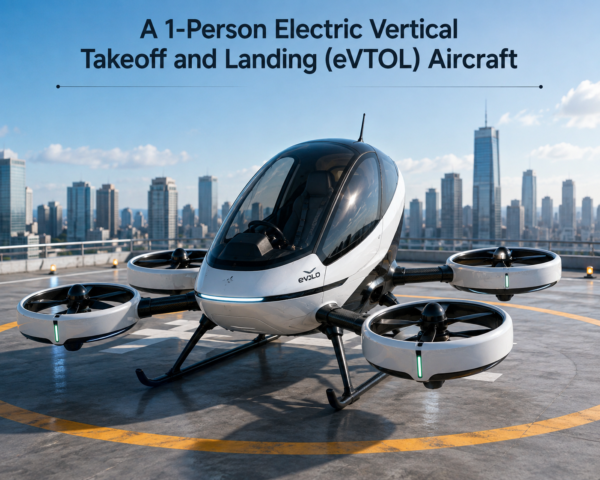
Flying Motors and the Rise of Personal Aerial Mobility
For most of human history, the ability to fly belonged to birds, machines and a very small number of trained pilots. The automobile transformed personal transportation by giving individuals freedom to move across the ground whenever and wherever roads allowed. Aviation transformed long-distance travel, but it remained largely centralized around airports, runways and professional operators. The next major transformation may be the gradual emergence of personal aerial mobility: compact aircraft that allow individuals to move through the air with far less dependence on conventional airports. At the center of this transformation are electric motors, distributed propulsion, advanced batteries, sophisticated flight computers and electric vertical takeoff and landing aircraft, commonly known as eVTOLs.
The phrase “flying motors” captures something important about this technological transition. The future aircraft may not be dominated by one enormous engine in the traditional sense. Instead, propulsion can be distributed among several small electric motors, each connected directly to a propeller or rotor and controlled electronically. This architecture is fundamentally different from the mechanical complexity of a conventional helicopter. Electric motors can be compact, independently controlled and arranged across the aircraft, creating new possibilities for stability, redundancy and aerodynamic design. What looks from the outside like a collection of spinning rotors is actually part of a highly coordinated digital propulsion system in which software can continuously determine how much thrust each motor should produce.
The rise of personal aerial mobility is part of a much larger movement that NASA calls Advanced Air Mobility, or AAM. NASA describes AAM as an emerging transportation system designed to move people and goods off the ground and into low-altitude airspace, including passenger transportation, cargo delivery and public-service applications. The agency is conducting research into aircraft, automation, noise, airspace integration and other technologies needed to make this new transportation layer practical. NASA’s stated objective is to provide data that can help industry develop electric air taxis and drones while assisting the Federal Aviation Administration in integrating them safely into the national airspace system.
The distinction between personal aerial mobility and conventional aviation is crucial. Traditional aviation generally asks passengers to travel to an airport before entering an aircraft. Personal aerial mobility attempts to bring the aircraft closer to the passenger. Instead of driving for an hour to reach an airport, a person could eventually travel to a neighborhood vertiport or another approved landing location and board a small electric aircraft. The aircraft would rise vertically, travel directly toward its destination and descend without requiring a conventional runway. In its most advanced form, the concept could create a three-dimensional transportation network operating above the existing road system.
This idea sounds futuristic, but many of its underlying technologies already exist. Electric motors are highly developed. Drone technology has demonstrated the practicality of distributed propulsion and computer-assisted stabilization. Lithium-ion batteries have become sufficiently capable to power small aircraft for short-duration flight. Lightweight carbon-fiber structures can reduce aircraft mass. Satellite navigation, inertial sensors, radar, cameras and sophisticated flight-control computers can provide aircraft with increasingly detailed information about their surroundings. The challenge is no longer finding one revolutionary technology. It is integrating dozens of technologies into an aircraft that is safe, efficient, affordable and certifiable.
The drone revolution has been particularly important. Small unmanned aircraft demonstrated that a machine with multiple electric motors can remain stable in the air while constantly adjusting individual propeller speeds. This was a major conceptual breakthrough for personal flight. Earlier attempts at compact personal aircraft often required the pilot to manage complicated mechanical systems. Modern electric multicopters can instead use software to perform much of the stabilization automatically. A human can command movement while the flight computer manages the continuous adjustments required to keep the aircraft balanced.
This technological lineage helps explain why personal aerial mobility has developed so quickly. The consumer drone industry created enormous demand for small electric motors, electronic speed controllers, compact batteries, inertial measurement units, cameras, GPS modules and miniature flight computers. Manufacturing volumes increased, components became smaller and software became more sophisticated. Engineers working on personal eVTOL aircraft could therefore build upon an ecosystem that had already been developed for drones rather than starting from the technological foundation of twentieth-century aviation.
The Jetson ONE is one of the most recognizable examples of the personal aerial vehicle concept. Developed by Jetson, it uses eight electric motors and a lightweight aluminum space-frame structure. The company publishes a flight time of approximately 20 minutes, a software-limited maximum speed of 102 km/h, a maximum pilot weight of 95 kilograms and a total aircraft mass of approximately 115 kilograms including batteries. Its published safety features include redundant propulsion, emergency functions, radar-assisted automatic landing and a ballistic parachute. Jetson currently states that it is taking orders for 2028.
The importance of aircraft such as the Jetson ONE is not necessarily their present-day performance. Their greater importance lies in proving that a personal aircraft can be designed around electric distributed propulsion rather than simply shrinking a conventional helicopter. This is an entirely different design philosophy. The machine does not need to carry several passengers, large amounts of fuel or the mechanical systems associated with a conventional aircraft. Its entire architecture can be optimized around one person, short-duration flight, electronic control and vertical access.
The fundamental problem remains energy. Flying is extraordinarily demanding because gravity never stops. An aircraft must continuously generate enough lift to support itself, its passengers and its energy-storage system. In an automobile, the wheels transfer the vehicle’s weight to the road. In an aircraft, the propulsion system must ultimately support that weight in the air. Batteries therefore create a difficult paradox. More batteries provide more energy, but more batteries also add mass, which requires more energy to fly.
Vertical flight makes this problem even harder. During takeoff, an eVTOL cannot initially depend on aerodynamic lift from wings because it has little or no forward velocity. The rotors must generate sufficient upward thrust to lift the entire aircraft. Hovering can therefore require substantial power. Once a winged aircraft accelerates, however, its wings begin producing lift and the propulsion system can devote more of its energy to forward motion. This is one reason why the future of personal aerial mobility will probably contain several different aircraft configurations rather than one universal design.
Pure multicopters represent the simplest approach. Several rotors provide vertical lift and directional control, allowing the aircraft to rise, descend, move forward, move sideways and rotate without conventional wings. Their simplicity and maneuverability are attractive for short-distance personal flight. Their limitation is efficiency. Because the rotors must continually generate lift, a pure multicopter can consume substantial energy during cruise.
Winged eVTOL aircraft approach the problem differently. They use electric propulsion to take off vertically and then rely on aerodynamic lift during forward flight. This can significantly improve cruise efficiency. The challenge is designing a safe transition between the two flight modes. Tilt-rotor aircraft rotate their propulsion units from vertical to horizontal orientation. Tilt-wing aircraft move their wings and propulsion systems. Lift-plus-cruise designs use separate propulsion systems for vertical lift and forward flight. Each approach represents a different compromise among efficiency, mechanical complexity, weight, redundancy and performance.
The future of personal aerial mobility may therefore be defined by specialization. A small recreational aircraft designed to fly for fifteen or twenty minutes does not need the same architecture as an electric air taxi designed to transport several passengers over much longer distances. A medical-response aircraft has different priorities from a private commuter aircraft. A cargo vehicle can sacrifice passenger comfort for payload capacity. An autonomous rural aircraft may have completely different requirements from an urban vehicle operating among hundreds of other aircraft.
The electric motor itself is one of the strongest arguments for this new form of aviation. Electric motors can deliver high torque almost immediately, can be precisely controlled and can be scaled into multiple independent propulsion units. A conventional aircraft may have one or a few major engines, while an eVTOL can distribute thrust across numerous motors. This gives engineers another way to think about aircraft reliability. Instead of depending on one large propulsion system, the aircraft can potentially continue operating after certain individual failures.
That redundancy does not mean that electric aircraft are automatically safe. Batteries, motors, controllers, wiring, sensors, computers, structures and software can all fail. Multiple failures can occur simultaneously. Thermal runaway within a battery can be particularly serious because a high-energy battery is both the aircraft’s energy source and a major part of its mass. Aviation-grade battery systems therefore require careful thermal management, monitoring, containment and fault detection.
Safety is ultimately the defining challenge of personal aerial mobility. It is relatively easy to make an aircraft that can fly for a few minutes. It is much harder to make an aircraft that can safely perform thousands or millions of flights over populated areas. The standard for commercial aviation is extremely high because an aircraft failure can affect not only the people aboard but also everyone beneath it. Personal aerial mobility must therefore develop systems that can tolerate individual component failures and provide predictable emergency responses.
This is where redundancy and automation become inseparable. If an aircraft has several motors, the flight computer must know when one is malfunctioning and immediately redistribute thrust. If a sensor becomes unreliable, another sensor must be available. If the aircraft detects a dangerous battery condition, it must determine whether to continue flying, divert or land. If navigation data becomes unreliable, the aircraft needs a safe fallback. In a mature personal aerial-mobility system, safety will increasingly come from the coordinated behavior of many independent systems rather than from one mechanical component.
Emergency landing capability is especially important for rotor-based personal aircraft. An airplane can potentially glide after losing propulsion, and a helicopter has autorotation as an emergency aerodynamic capability. A compact multicopter may have fewer passive options if all propulsion is lost. Some personal aircraft therefore incorporate ballistic parachutes or other emergency descent systems. The objective is not to assume that accidents will never happen but to provide an additional layer of protection when normal flight becomes impossible.
Automation will probably be one of the biggest factors determining whether ordinary people can eventually use personal aircraft. Flying a conventional helicopter requires substantial training because the pilot must continuously coordinate multiple controls while monitoring altitude, speed, attitude, navigation and surrounding traffic. A highly automated eVTOL can shift much of that workload to the flight computer. The pilot could provide high-level commands while software maintains stability and manages individual motors.
This does not necessarily mean that personal aerial mobility will become pilot-free. In the early stages, regulators are likely to require trained pilots for many operations. The Federal Aviation Administration’s 2024 powered-lift rule established a framework for pilot certification, training and operations for the new powered-lift category. The FAA described these aircraft as having characteristics of both airplanes and helicopters and created operating provisions intended to support their integration into the National Airspace System.
The regulatory development is historically significant because the FAA described powered lift as the first completely new category of civil aircraft since helicopters were introduced in the 1940s. The agency specifically identified potential uses ranging from urban passenger transportation and short-haul operations to air ambulance services, cargo transportation and eventual service to smaller communities. This demonstrates that regulators are no longer treating electric vertical aircraft simply as experimental curiosities. They are building a framework for their potential integration into real transportation systems.
Certification is, however, only one part of the challenge. An aircraft can be certified and still be commercially impractical. It must be manufactured consistently, maintained economically, charged efficiently and operated in an environment where infrastructure exists. Personal aerial mobility therefore requires an ecosystem rather than merely an aircraft.
Vertiports are likely to become the physical nodes of that ecosystem. Unlike conventional airports, a vertiport may occupy a much smaller footprint, potentially on rooftops, parking structures or transportation hubs. But a vertiport still needs safe landing areas, electrical power, passenger access, emergency equipment and appropriate separation from surrounding structures. As traffic grows, vertiports will also need systems for scheduling arrivals and departures, charging aircraft and managing congestion.
Recent industry developments illustrate this shift toward infrastructure. Joby Aviation announced a partnership in 2026 with robotics company Atoms to develop mobility hubs combining eVTOL operations with other forms of transportation such as robotaxis. The planned hubs are intended to support landing, charging and connections between different transportation modes. This is an important development because it suggests that the future of aerial mobility may not involve isolated landing pads but integrated transportation hubs where air travel connects directly with ground mobility.
Charging infrastructure could become one of the hidden determinants of success. A personal aircraft may be able to fly only a limited amount before requiring recharging, and commercial operators will need rapid turnaround between flights. Vertiports could therefore require substantial electrical capacity. They may also need stationary energy-storage systems to manage peak demand. In some applications, battery swapping could potentially provide faster turnaround than conventional charging, although aviation-grade battery swapping introduces its own safety and logistical challenges.
The energy problem also explains why personal aerial mobility is likely to remain short-range initially. The first successful applications do not need to compete with commercial airplanes. Their strongest value may come from eliminating short ground journeys through congested or geographically difficult environments. A ten-minute flight that replaces a ninety-minute road journey could be highly valuable even if the aircraft cannot fly for several hours.
This makes urban mobility one of the most discussed applications. Imagine a metropolitan region in which commuters can travel between suburban and central vertiports without following roads. A journey that normally depends on traffic could instead follow a relatively direct aerial route. For business travelers, emergency workers and high-value passengers, the time savings could justify the cost.
But the urban environment also creates the greatest challenges. Buildings produce complex airflow. Populations are dense. Noise matters. Airspace is already occupied by conventional aircraft, helicopters and drones. Emergency landing options may be limited. Thousands of aircraft operating simultaneously would create a completely new traffic-management problem.
The answer is likely to involve digital airspace management. Future personal aircraft may continuously communicate their location, intended route, altitude and operating status to a broader traffic-management system. Automated systems could assign routes, maintain separation and redirect aircraft around weather or congestion. NASA’s AAM program specifically researches airspace integration and the technologies required to safely introduce electric air taxis and other advanced aircraft into low-altitude airspace.
This could eventually create something resembling a “highway in the sky,” but the comparison should not be taken too literally. Roads are largely two-dimensional networks with intersections and traffic signals. Aerial mobility could use three-dimensional corridors, altitude layers, dynamically assigned routes and digital separation. Instead of traffic lights, aircraft might receive automated clearances. Instead of road signs, navigation systems would provide digital restrictions and routing information.
Artificial intelligence could become the invisible infrastructure behind this system. AI algorithms could optimize flight paths, predict congestion, manage battery energy, detect abnormal aircraft behavior and assist with collision avoidance. Research institutions are already developing simulation environments and algorithms specifically for Advanced Air Mobility traffic management and separation assurance. One MIT Lincoln Laboratory research effort, for example, developed an AAM testbed for evaluating AI approaches to aircraft separation and traffic-management problems.
However, AI introduces its own safety questions. A transportation network cannot rely on algorithms that simply work most of the time. They must be predictable, verifiable and robust under unusual circumstances. Cybersecurity also becomes increasingly important as aircraft become connected to navigation networks, vertiports and traffic-management systems. The more digitally integrated the aircraft becomes, the more important secure communication, authentication, redundancy and resilient fallback modes become.
Noise could prove to be one of the biggest social barriers. Electric motors themselves can be comparatively quiet, but the propellers and rotors still produce aerodynamic noise. A large number of aircraft operating above residential neighborhoods could create a significant acoustic burden even if the aircraft are far quieter than conventional helicopters. NASA is therefore studying the human response to air-taxi noise and the aerodynamic sources of eVTOL sound.
The objective will not be absolute silence. That is physically unrealistic for a vehicle that must move enough air to lift itself. Instead, engineers will need to reduce the frequency, intensity and duration of noise while designing flight paths and operating procedures that minimize disturbance. Larger, slower-turning rotors, optimized blade shapes and carefully managed motor speeds could all contribute to quieter flight.
The economics of personal aerial mobility present another major question. The first flying machines are unlikely to be cheap. Aircraft-grade batteries, electric motors, avionics, sensors, structural materials, certification and maintenance all cost money. The owner also needs somewhere to store and charge the aircraft. Insurance and pilot training could add further expenses. In its early years, personal aerial mobility may therefore resemble private aviation rather than automobile ownership.
Mass manufacturing could eventually change the equation. Electric propulsion lends itself to modular production. Motors, controllers, batteries and sensors can be standardized across aircraft families. Manufacturing techniques developed for automobiles and drones could potentially be adapted to aerospace applications, although aircraft certification imposes much stricter requirements than consumer electronics or road vehicles.
The personal aerial vehicle could eventually occupy a category somewhere between a motorcycle, private aircraft and advanced drone. It may not replace the family car, but it could provide a new option for short-distance travel, recreation, inspection, emergency response and specialized transportation. The most successful vehicles may not be designed to do everything. They may be highly optimized for a specific mission.
Rural areas could become some of the earliest beneficiaries. In a dense city, every flight creates noise and safety concerns. In rural regions, there may be more space and fewer obstacles. A compact aircraft could cross rivers, forests and mountainous terrain without requiring roads. Medical teams could reach remote communities more rapidly. Agricultural operators could inspect large areas. Utility companies could monitor infrastructure. Search-and-rescue teams could reach isolated locations.
The medical potential is particularly compelling. Emergency transportation is fundamentally a race against time. An electric vertical aircraft could potentially bypass roads and traffic and transport medical personnel, equipment or patients directly between locations. The broader AAM ecosystem already includes medical transportation among the potential applications recognized by aviation authorities.
Cargo may also prove important. An autonomous eVTOL carrying medical supplies, emergency equipment or high-value goods does not require passenger seating or the same level of comfort. Cargo missions could therefore provide an intermediate commercial application while passenger operations are still developing. They could also allow operators to gather real-world experience with automated navigation and vertiport infrastructure.
Personal aerial mobility could eventually change emergency management more broadly. During floods, earthquakes, wildfires or major infrastructure failures, roads may become unusable. Small electric aircraft could potentially move people and supplies over damaged infrastructure. NASA’s AAM program includes public-service and emergency-response concepts as part of the broader ecosystem.
The environmental case is attractive but needs to be examined honestly. Electric aircraft produce no direct exhaust emissions during flight, but batteries require energy and raw materials to manufacture, and the electricity used for charging must come from somewhere. The environmental advantage therefore depends on the electricity mix, battery manufacturing, aircraft utilization and the transportation mode being replaced.
An eVTOL replacing a helicopter could offer a very different environmental profile from an eVTOL replacing an electric train. The technology should therefore not be viewed as automatically “green” simply because it uses electric motors. Its environmental value will depend on where it is deployed and what transportation behavior it changes.
Personal aerial mobility also raises a fundamental question of social equity. If flying becomes technically possible but remains extremely expensive, the technology could simply create a premium transportation system for wealthy individuals. A city could theoretically have fast aerial mobility for a small group while the majority remain stuck in ground traffic. The long-term social value of eVTOL transportation will therefore depend not only on technological performance but on affordability and accessibility.
There is another risk: the sky could become congested just as roads are congested today. If every individual commuter uses a personal aircraft, the advantage of direct aerial transportation could disappear beneath enormous traffic-management complexity. This is why shared air taxis and coordinated fleets may ultimately prove more efficient than universal private ownership. A fleet of aircraft can be scheduled continuously, whereas privately owned aircraft may sit unused for most of the day.
This creates an interesting tension between the idea of personal freedom and the economics of shared transportation. The personal flying machine promises individual control, but the most efficient aerial transportation system may involve centrally managed fleets. The future may therefore contain both models: privately owned personal aircraft for enthusiasts and specialized users, alongside shared autonomous eVTOL fleets for mass transportation.
The psychological barrier should not be underestimated either. People are accustomed to cars because a malfunctioning car generally remains on the ground. Aircraft operate under a different risk model. For personal aerial mobility to become normal, the public must develop confidence that aircraft can handle component failures, changing weather, navigation errors and unexpected situations safely.
That confidence will not be created by advertising. It will come from reliability statistics and operational experience. A successful future eVTOL industry will need millions of safe flights, predictable maintenance records and transparent safety standards. One spectacular demonstration flight proves very little. A mature transportation system must demonstrate reliability every day.
This is why certification represents such an important transition. The FAA and European Union Aviation Safety Agency have been working toward greater alignment in the certification of eVTOL aircraft, with the FAA identifying progress toward type certification as an important milestone for the industry. Certification does not guarantee commercial success, but it creates the technical and regulatory foundation on which commercial operations can be built.
The evolution of the aircraft itself is also likely to continue. Today’s personal eVTOLs may have exposed rotors, open cockpits and relatively short endurance. Future versions could have enclosed cabins, weather protection, more aerodynamic bodies, higher-energy batteries and advanced obstacle detection. Some may have wings that unfold or rotate. Others may retain multicopter configurations because simplicity and maneuverability are more important than long range.
Battery technology will remain the single greatest technological variable. A major improvement in energy density could change the economics of personal flight almost overnight. A lighter battery could increase range, payload or safety reserves without requiring a proportional increase in aircraft size. NASA and other research organizations continue to investigate advanced energy-storage technologies because the performance of future electric aviation depends heavily on energy density, safety and durability.
Yet batteries alone will not create the flying future. Improvements in motors, power electronics, aerodynamics and software can be equally important. An aircraft that uses ten percent less energy per kilometer effectively receives a ten percent increase in usable battery range without changing the battery itself. Intelligent routing can further reduce energy consumption by selecting efficient altitudes and trajectories.
The aircraft may eventually become an energy-management computer with wings. Before takeoff, it could calculate the expected energy requirement based on weight, weather and route. During flight, it could continuously monitor battery temperature and state of charge. If conditions change, it could adjust speed or route to preserve an emergency reserve. If a component begins to fail, it could prioritize safety and identify the nearest suitable landing site.
This type of intelligence could transform the pilot’s relationship with the aircraft. Instead of manually controlling every aspect of flight, the human may increasingly supervise an automated system. The aircraft would become less like a conventional helicopter and more like a sophisticated robotic transportation platform.
The concept of “flying motors” therefore has a deeper meaning than simply putting electric motors on an aircraft. It represents the convergence of propulsion and computation. The motor is no longer an isolated machine that produces thrust. It becomes one node in a network of sensors, controllers, batteries and algorithms. Each motor knows how much power it should provide because the aircraft’s computer continuously calculates what the entire vehicle needs.
That architecture could eventually make aircraft much more adaptable. Software updates could improve energy management, flight characteristics and diagnostic capabilities. Different aircraft configurations could share common propulsion modules. Maintenance systems could automatically report motor performance and battery degradation. The aircraft could become increasingly software-defined.
The same technological foundation could also extend beyond passenger mobility. Electric propulsion, distributed motors and autonomous control can support cargo aircraft, agricultural systems, emergency vehicles, inspection platforms and military applications. Indeed, current developments show that eVTOL technologies are attracting interest beyond civilian transportation. In 2026, South Korea’s Korean Air and Archer Aviation announced cooperation to adapt Archer’s Midnight eVTOL platform for military applications including troop transport, cargo, medical evacuation, search and rescue and special operations.
This illustrates another important characteristic of emerging aviation technologies: the boundary between civilian and specialized aircraft can become increasingly fluid. A propulsion system developed for a passenger aircraft may later support cargo or emergency missions. A navigation system developed for autonomous drones may eventually help personal aircraft. A battery-management technology developed for one application can benefit many others.
The future of personal aerial mobility may also be shaped by the geography of individual countries. Regions with congested megacities, difficult terrain or limited ground infrastructure may have stronger incentives to develop aerial transportation. Countries with large technology and aerospace industries may become early centers of eVTOL manufacturing. Regulatory environments will also influence where commercial operations emerge first.
In India, for example, the potential applications are particularly interesting because the country combines extremely dense urban regions with large rural areas, difficult terrain and rapidly growing demand for transportation. India’s aerospace and engineering ecosystem is also increasingly involved in eVTOL development. A 2026 discussion with a senior executive from Chennai-based ePlane Company highlighted the company’s work on eVTOL aircraft and emphasized emergency medical response as a potentially transformative application. While individual company claims and timelines require independent verification, the broader point is significant: emerging economies may find medical, emergency and regional connectivity applications especially compelling before mass-market personal flying becomes realistic.
The most likely future is therefore not a sudden world filled with millions of flying cars. It is a gradual layering of aerial mobility onto existing transportation. First come specialized operations. Then controlled air-taxi routes. Then larger networks of vertiports. Then increasing automation. Eventually, if costs fall and regulations evolve, personal aircraft may become more common.
The transformation could be almost invisible at first. A few aircraft operating between airports and downtown locations may not seem revolutionary. But once people begin to think of the sky as another transportation route, expectations could change rapidly. A journey across a congested metropolitan area could become something that people routinely consider in three dimensions.
The rise of personal aerial mobility is therefore not simply a story about aircraft. It is a story about the gradual disappearance of the traditional boundary between transportation and robotics. Cars are becoming increasingly autonomous. Drones are becoming increasingly intelligent. Electric motors are becoming increasingly powerful and efficient. Batteries are becoming increasingly capable. Aircraft are becoming increasingly computerized. These technologies are converging into machines that can sense, calculate and move through the environment with increasing independence.
The central question is no longer whether humans can build a small electric aircraft that flies. That question has already been answered. The real questions are harder: Can it fly safely thousands of times? Can it operate quietly over communities? Can it be charged quickly enough? Can its batteries provide sufficient reserves? Can thousands of aircraft share the same airspace? Can regulators certify autonomous systems? Can infrastructure support them? Can ordinary people afford them? And can society accept a transportation system that places aircraft above everyday life?
If those questions are answered successfully, the consequences could be profound. The personal aircraft could evolve from a recreational novelty into a new category of mobility. The commuter could travel above traffic. The rural resident could reach a distant city without a long road journey. Emergency responders could cross damaged infrastructure. Medical teams could reach remote patients. Cargo could move directly between locations. Cities could develop transportation hubs where road vehicles, rail systems and aircraft meet.
The most important development may ultimately be the creation of an integrated mobility ecosystem rather than a single spectacular aircraft. A successful system will require aircraft, batteries, motors, charging stations, vertiports, navigation networks, traffic-management systems, weather services, cybersecurity, regulations and human operators. Every component must work with the others.
In that sense, the rise of personal aerial mobility resembles the birth of the automobile industry more than the invention of a new aircraft. The first automobiles were fascinating machines, but the automobile revolution required roads, fuel stations, manufacturing plants, traffic rules, repair shops, insurance systems and cultural acceptance. Personal aerial mobility will require its own equivalent infrastructure. The aircraft is only the beginning.
The phrase “flying motors” may therefore sound almost primitive compared with what the technology is becoming. The future machine will not simply be a motor that flies. It will be an intelligent, connected and energy-aware aerial system capable of sensing its environment, managing its own propulsion, communicating with other aircraft and potentially navigating with minimal human intervention.
The ultimate promise is not that everyone will suddenly own a flying car. It is that the physical constraints separating people from the places they want to reach could begin to weaken. Roads will still matter. Railways will still matter. Airports will still matter. But the sky could become another layer of everyday mobility.
That is the real significance of personal aerial mobility. It represents the possibility of moving from a transportation system built almost entirely on the ground to one that operates across three dimensions. Electric motors make the aircraft cleaner and more controllable. Distributed propulsion makes new configurations possible. Batteries provide the energy. Software provides stability and intelligence. Automation provides accessibility. Vertiports provide the physical network. Digital airspace management provides coordination. Regulation provides the framework.
The revolution, if it comes, will therefore not be created by one flying machine. It will emerge from the interaction of all these technologies. The first personal aircraft may have short endurance, limited range and high prices. But each generation can become lighter, quieter, safer, smarter and more efficient.
The dream of personal flight has survived for generations because it represents something deeper than transportation. It represents freedom from the limitations of the ground. Electric propulsion is giving that old dream a new technological foundation. What once required enormous engines and complicated mechanical systems can increasingly be accomplished with compact motors, sophisticated batteries and intelligent computers.
The age of personal aerial mobility is still in its early stages, and substantial obstacles remain. But the direction is becoming increasingly clear. The future of flight may not belong exclusively to massive airliners, military aircraft and conventional helicopters. It may also belong to small electric machines that rise vertically, navigate digitally and carry individuals directly through the air.
The road created the age of personal mobility. The electric motor is now helping create the possibility of personal mobility above the road. And if engineers, regulators and society can solve the difficult problems of energy, safety, infrastructure, affordability and airspace integration, the sky may gradually become not merely a place where aircraft travel, but a new everyday layer of human transportation.