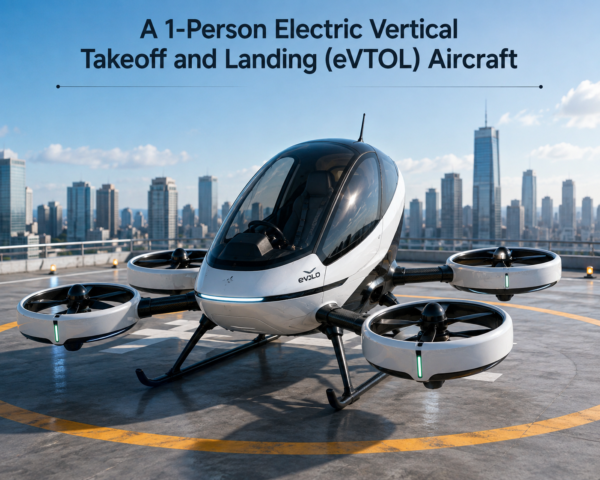
Electric Vertical Takeoff and Landing (eVTOL) Aircraft
The Technology That Could Redefine the Future of Aviation
Electric Vertical Takeoff and Landing, commonly abbreviated as eVTOL, represents one of the most ambitious transformations taking place in modern aviation. The basic idea is deceptively simple: develop aircraft that can rise vertically from the ground, hover without a runway, transition into efficient forward flight when required, and land vertically, while using electric propulsion instead of conventional jet fuel or piston engines. Behind that simple description, however, lies a convergence of battery technology, electric motors, lightweight structures, advanced aerodynamics, autonomous flight controls, artificial intelligence, digital navigation, air-traffic management and new aviation regulations. The result is not merely a new type of aircraft. It is an attempt to create an entirely new layer of transportation in which people and cargo can move through the air directly between locations without depending on traditional airports and road networks.
The significance of eVTOL aircraft becomes easier to understand when compared with conventional transportation. Cars are constrained by roads and traffic. Trains require tracks. Conventional airplanes require runways and airports. Helicopters offer vertical takeoff and landing, but they are expensive to operate, mechanically complex and typically dependent on combustion engines and conventional rotor systems. eVTOL aircraft attempt to combine the greatest advantages of several categories: the vertical-access capability of helicopters, the cruise efficiency of airplanes, the distributed propulsion possibilities of electric motors and, potentially, the automation and digital connectivity of modern unmanned aircraft. NASA describes the broader Advanced Air Mobility vision as an emerging transportation system that could move passengers and cargo across cities, between neighboring cities and to destinations that are currently reached primarily by road.
The term eVTOL covers a remarkably broad family of aircraft rather than one particular design. Some eVTOLs resemble multicopters, with numerous rotors arranged around a central fuselage. Others have conventional wings and multiple electric propellers. Some use rotors that tilt between vertical and horizontal positions, while others use separate lift rotors for takeoff and landing and dedicated propellers for forward cruise. There are also hybrid-electric designs in which electric propulsion is combined with another energy source to extend range. This variety exists because engineers are trying to solve a fundamental problem: vertical flight requires enormous power, while efficient forward flight requires an aircraft that can exploit aerodynamic lift rather than continuously holding itself up with rotor thrust.
The physics of vertical flight explains much of the engineering challenge. When an aircraft is hovering, its propulsion system must generate enough upward thrust to balance the entire weight of the aircraft. Unlike an airplane cruising forward, a hovering aircraft cannot initially rely on its wings to provide most of the lift. Its motors therefore have to move a significant mass of air downward. This consumes substantial power. Once a winged eVTOL accelerates forward, however, its wings begin generating aerodynamic lift, allowing the propulsion system to focus primarily on forward motion. Consequently, the most efficient eVTOL designs are not necessarily the ones with the greatest number of rotors or the largest motors. They are the designs that manage the transition between vertical flight and wing-borne cruise with the least possible energy penalty.
This is where the concept of distributed electric propulsion becomes particularly important. Conventional aircraft often depend on a small number of large engines, while many eVTOL designs distribute propulsion across several smaller electric motors. Electric motors are particularly suitable for this architecture because they can be relatively compact, independently controlled and installed in multiple locations. If a vehicle has several propulsion units, the flight-control system can continuously adjust their thrust to control pitch, roll, yaw and altitude. The result is an aircraft that can potentially achieve extraordinary levels of control without the complicated mechanical transmission systems traditionally associated with helicopters.
The absence of a conventional mechanical drivetrain is one of the most attractive aspects of electric propulsion. A traditional helicopter has an engine, transmission, gearbox, shafts and a highly sophisticated rotor system. An electric eVTOL can potentially replace much of that mechanical complexity with batteries, power electronics, motors and software. This does not mean that an eVTOL is mechanically simple overall, because the aircraft introduces new challenges in electronics, thermal management, software and energy storage. Nevertheless, electric motors contain comparatively few moving components, which creates the possibility of reduced mechanical maintenance and highly modular propulsion systems.
The battery is therefore the central technological constraint. Electric motors themselves are already highly capable, but batteries remain much heavier than the energy storage systems used in conventional aviation fuels when measured by mass-specific energy. A liter of aviation fuel contains enormous chemical energy, and a combustion engine can continuously replenish propulsion power as long as fuel remains available. An electric aircraft must carry its energy storage system throughout the flight. Worse, the battery contributes directly to aircraft weight, which means that increasing battery capacity also increases the amount of lift and energy required. This creates a fundamental engineering trade-off between range, payload, battery mass and safety reserves.
Battery performance becomes even more critical because an eVTOL needs both high energy and high power. Energy determines how long the aircraft can remain airborne, while power determines how quickly it can generate thrust during vertical takeoff, climbing and certain emergency conditions. An aircraft may have enough total battery energy for a long flight but still require a battery system capable of delivering very high instantaneous power. Battery-management systems must therefore monitor temperature, voltage, current, state of charge and degradation with extremely high reliability. Recent research into eVTOL battery systems is exploring advanced predictive models and physics-informed battery-management approaches precisely because aggressive flight profiles place unusual demands on lithium-ion systems.
This is one reason why the future of eVTOL aircraft is closely tied to the development of next-generation batteries. Improvements in energy density could fundamentally change aircraft design. If a battery can store substantially more energy for the same mass, designers could increase range without dramatically increasing aircraft weight. The additional energy could alternatively be used to provide larger safety reserves, greater payload capacity or more flexible operating conditions. Technologies such as solid-state batteries, lithium-sulfur systems and other advanced chemistries are therefore attracting enormous interest, although laboratory-level energy-density promises should not be confused with mature, certified aviation products.
The aircraft’s aerodynamic configuration is equally important. A pure multicopter is mechanically and conceptually straightforward because its rotors provide both lift and control. It can take off vertically, hover and move in almost any direction. Its weakness is cruise efficiency. Because it does not necessarily have a large wing providing aerodynamic lift, its rotors must continue consuming substantial energy to keep the aircraft airborne. For short urban journeys, this may be acceptable. For longer routes, however, the energy penalty becomes significant.
Winged eVTOL aircraft address this limitation by using aerodynamic lift during cruise. Once the aircraft has accelerated, its wings carry most of its weight. This can dramatically reduce the amount of power needed to remain airborne. The difficulty is that wings are not useful during a stationary vertical takeoff. The aircraft therefore needs a propulsion system capable of generating vertical thrust and then transitioning safely into forward flight. Tilt-rotor, tilt-wing and lift-plus-cruise configurations are different engineering solutions to this same fundamental problem.
Tilt-rotor aircraft use propulsion units that change orientation. During takeoff, the rotors point upward and generate vertical lift. During cruise, they rotate forward and act more like conventional airplane propellers. This allows the same propulsion system to perform two jobs, but the transition mechanism adds mechanical and aerodynamic complexity. Lift-plus-cruise aircraft take a different approach by using dedicated vertical-lift rotors for takeoff and separate propellers for forward flight. This can simplify the transition because the propulsion functions are separated, but it means that some motors and rotors may contribute little or nothing during cruise while still being carried throughout the flight.
The broader eVTOL industry is therefore engaged in a fundamental optimization problem. Engineers must decide where to place the aircraft’s motors, how large its rotors should be, whether it needs wings, whether propulsion should tilt, how the aircraft should transition between flight modes and how much redundancy should be built into the system. There is no universal answer because the ideal design depends on the intended mission. An aircraft designed to carry passengers five or ten kilometers across a congested city may look very different from an aircraft designed to connect two cities hundreds of kilometers apart.
Safety is perhaps the most important difference between an experimental flying machine and a commercially viable eVTOL aircraft. It is relatively easy to demonstrate that a prototype can take off and fly. It is much harder to demonstrate that thousands of aircraft can perform thousands of flights while maintaining aviation-grade reliability. The challenge becomes particularly serious because eVTOL aircraft are expected to operate closer to populated areas than many conventional aircraft. A failure in an urban environment could affect not only the occupants but also people and property on the ground.
Distributed propulsion can contribute to safety because multiple motors create redundancy. If a single motor fails, a sufficiently sophisticated control system may compensate by increasing or redistributing thrust among the remaining motors. But redundancy must extend beyond the motors themselves. Critical flight-control computers, electrical power systems, sensors, communications, navigation systems and software must be designed so that a single failure does not automatically result in loss of control. The aircraft must also have defined emergency procedures for battery faults, propulsion failures, sensor failures and unexpected weather.
This is where software becomes as important as hardware. Modern eVTOL aircraft are essentially flying computers with wings and rotors attached. Flight-control software can continuously calculate how much thrust each motor should produce, compensate for disturbances and maintain stable flight. More advanced systems can monitor aircraft health, predict faults and assist with navigation. As automation develops, the software could eventually handle increasingly complex tasks, reducing the amount of manual flying required from the pilot.
Autonomy is therefore likely to become one of the defining characteristics of mature eVTOL transportation. A future aircraft may be capable of performing automated takeoff, route selection, obstacle detection, transition, cruise and landing. The human passenger or pilot may interact with the aircraft more like someone operating an advanced transportation system than someone manually flying a helicopter. However, complete autonomy raises new questions about cybersecurity, certification, liability and public trust. A 2026 academic survey of eVTOL security challenges identifies risks including GPS spoofing and jamming, attacks involving communication systems, vulnerabilities in automated flight-management systems and new security risks created by highly connected aircraft.
Cybersecurity will become increasingly important because an eVTOL transportation network will be far more digitally connected than traditional general aviation. Aircraft may exchange information with vertiports, traffic-management systems, weather services, navigation networks, maintenance databases and cloud infrastructure. Connectivity creates efficiency, but it also creates potential attack surfaces. A future air-mobility system therefore cannot treat cybersecurity as an optional software feature. It must be incorporated into the architecture from the beginning, with secure communications, authentication, redundancy and robust fallback modes.
Navigation and traffic management present another major challenge. Imagine a future city in which thousands of eVTOL aircraft are simultaneously moving between rooftops, suburban vertiports, airports and neighboring cities. Unlike today’s small-scale helicopter operations, such a system would require highly organized airspace management. Aircraft would need to know where other aircraft are, which routes are available, where weather hazards exist and where emergency landing areas are located. Automated traffic coordination could become essential because human controllers alone may not be able to manage extremely high-density low-altitude airspace.
Research is already examining the energy consequences of traffic management. A 2026 study of eVTOL operations in high-density airspace found that conflict-resolution maneuvers generally imposed relatively small energy penalties in its simulated scenarios, although certain high-density situations produced much larger additional energy requirements. The finding illustrates a subtle but important point: air-traffic management is not only a safety problem. Every detour, holding pattern or avoidance maneuver consumes battery energy, and an electric aircraft cannot afford to treat energy reserves as an unlimited resource.
Weather creates another challenge that is sometimes overlooked in futuristic discussions about flying taxis. Wind, turbulence, rain, heat and visibility can all affect aircraft performance. An eVTOL must be able to maintain stable flight despite changing atmospheric conditions, while its battery and electrical systems must remain within safe operating temperatures. Urban environments can be particularly complicated because buildings create turbulent airflow and unpredictable wind patterns. NASA research into eVTOL rotor aerodynamics is examining how atmospheric turbulence affects both rotor performance and acoustic characteristics.
Noise is one of the most important factors that could determine whether eVTOL aircraft are welcomed by communities. The word “electric” sometimes creates the impression that these aircraft will be silent. They will not. Propellers and rotors inevitably generate aerodynamic noise because they must accelerate air to produce thrust. Nevertheless, electric propulsion gives engineers new opportunities to optimize rotor diameter, blade geometry, rotational speed and motor control. NASA has conducted acoustic measurements of eVTOL aircraft and has emphasized that noise reduction is essential if advanced air mobility is to coexist with communities.
The challenge is therefore not to make an aircraft completely silent but to make its acoustic footprint acceptable. This could involve larger, slower-turning rotors, optimized blade designs, carefully controlled rotor speeds and flight routes that minimize noise over residential areas. Aircraft may also be programmed to alter their operating profiles during takeoff and landing to reduce the acoustic impact on people below. In a mature eVTOL network, noise could become an optimization variable in the same way that fuel consumption and travel time are considered in conventional transportation.
Infrastructure will be equally important. The term “vertical takeoff and landing” creates the impression that eVTOL aircraft can operate anywhere. Technically, an aircraft may not require a conventional runway, but practical operations still require controlled takeoff and landing locations. Vertiports will need sufficient clearance, electrical power, fire protection, passenger facilities, emergency equipment and appropriate airspace connections. A high-volume eVTOL network could therefore create a new class of transportation infrastructure comparable in importance to airports, railway stations and highway interchanges.
Charging infrastructure could become particularly demanding. A commercial eVTOL may need to recharge quickly between flights, meaning that a vertiport serving many aircraft could require significant electrical power. This makes the future of electric aviation connected to the future of the electrical grid. Charging stations will need to manage peak demand, battery temperatures, charging rates and energy availability. In some cases, energy storage systems could be installed at vertiports to reduce stress on local electrical networks.
The commercial industry has already moved beyond pure experimentation toward certification and operational planning. In the United States, the Federal Aviation Administration finalized a regulatory framework in 2024 for powered-lift aircraft, including pilot certification, operating rules and integration into the national airspace system. The FAA specifically established a framework intended to accommodate powered-lift aircraft and created rules addressing pilot training and operations. This regulatory progress is important because aircraft developers cannot build a sustainable commercial industry without knowing how their vehicles will be certified, operated and integrated into existing aviation systems.
Companies such as Joby Aviation and Archer Aviation illustrate the industry’s transition from prototype development toward certification and commercial operations. Joby has continued its certification and flight-test campaign, while Archer is developing its Midnight aircraft and pursuing certification and planned commercial deployment. Current industry timelines remain subject to certification progress, operational approvals and other uncertainties, so announced commercial dates should be treated as targets rather than guarantees. Recent reporting indicates that Joby is continuing toward certification while Archer is also advancing its own program.
The commercial value proposition of eVTOL aircraft is based primarily on time rather than simply distance. A trip that takes an hour or two by car because of congestion could potentially be completed in a fraction of the time by air. The economic question is whether the aircraft can provide that time saving at a price that a sufficiently large number of customers are willing to pay. This is why early eVTOL services are likely to concentrate on premium routes where time has a high economic value, such as airport transfers, business travel and connections between dense urban centers.
Over time, economies of scale could change the economics. Electric motors may be manufactured in large numbers. Aircraft could be assembled using standardized components. Automated manufacturing could reduce labor requirements. Battery technology could improve. Maintenance procedures could become more predictable. As production volumes increase, the cost per aircraft could fall. But certification, insurance, infrastructure and maintenance will remain substantial costs, meaning that eVTOL aircraft are unlikely to become immediately equivalent to ordinary automobiles.
One of the strongest arguments for eVTOL transportation is that it could complement rather than replace existing transportation systems. An aircraft does not need to eliminate cars, buses or trains to be valuable. It can provide a faster option for particular routes where conventional transportation is inefficient. A passenger could travel by train between major cities and then use an eVTOL aircraft for the final connection. An airport could become a multimodal hub linking aircraft, rail, automobiles and air taxis. Rural communities could potentially gain faster access to hospitals, airports and major economic centers.
Emergency services may represent an especially valuable application. An eVTOL aircraft could potentially reach locations that are difficult for road vehicles to access. Medical transport, disaster response, search and rescue, infrastructure inspection and emergency logistics could all benefit from vertical flight. NASA’s broader Advanced Air Mobility research explicitly considers passenger and cargo transportation as well as the infrastructure, automation and airspace systems needed to support these operations.
Cargo transportation may actually become commercially viable in some markets before widespread passenger operations. Cargo does not require life-support systems, passenger comfort or the same cabin arrangements. Autonomous cargo eVTOLs could carry supplies between distribution centers, remote communities and industrial facilities. This would also allow operators to test automated flight systems in controlled environments before deploying them widely with passengers.
Military applications are another rapidly developing branch of the technology. Electric vertical aircraft can potentially offer low logistical footprints, reduced acoustic signatures and distributed propulsion. However, military systems may increasingly combine electric propulsion with hybrid-electric systems when long-range missions demand more energy than batteries alone can provide. Recent developments demonstrate that eVTOL-derived technology is already being adapted for military logistics and autonomous aircraft, showing how technologies initially developed for civil air mobility can cross into defense applications.
The environmental benefits of eVTOL aircraft are substantial in principle but should not be exaggerated. An electric aircraft produces no direct tailpipe emissions during flight, and its electric motors can be considerably cleaner at the point of use than combustion engines. But the overall environmental footprint depends on how electricity is generated, how batteries are manufactured, how often batteries are replaced and what transportation mode the eVTOL replaces. An electric air taxi replacing a helicopter could provide a meaningful environmental improvement. An eVTOL replacing an efficient electric train for a short journey would produce a very different environmental outcome.
The question of energy efficiency therefore matters enormously. An eVTOL aircraft may be cleaner than a conventional helicopter while still consuming considerably more energy per passenger-kilometer than a train. The technology makes the greatest sense where its unique capability—rapid point-to-point vertical transportation—creates value that cannot easily be achieved by ground transportation. The objective should not be to replace every form of transport with aircraft but to create another transportation layer where it makes practical and economic sense.
The social implications could be profound if the technology eventually becomes affordable. For decades, aviation has largely been a centralized system in which passengers travel to airports and board relatively large aircraft. eVTOL technology offers the possibility of decentralization. Instead of one giant airport serving an entire metropolitan region, a city could eventually have a network of smaller vertiports distributed throughout the area. Travel could become more direct, with passengers spending less time reaching and leaving major airports.
Yet decentralization also creates a risk of inequality. If eVTOL travel remains expensive, the technology could become primarily a premium transportation service for wealthy passengers. The result could be a two-tier transportation system in which affluent travelers move rapidly through the air while the majority remain dependent on crowded roads and public transportation. Whether eVTOL becomes a broadly accessible technology or a luxury service will depend heavily on manufacturing costs, regulation, infrastructure investment and business models.
There is also a question of urban design. If eVTOL aircraft become common, buildings may be designed with rooftop landing facilities, charging infrastructure and passenger access. Business districts could incorporate vertiports into transportation hubs. Hospitals could have dedicated landing facilities. Airports could establish separate eVTOL terminals. New residential developments might consider air-mobility access in the same way that today’s developments consider highways and railway stations.
The technology could also transform the concept of geographical distance. A city that is difficult to reach by road because of mountains, rivers or poor infrastructure could become much more accessible by air. In developing regions, where building roads and railways across difficult terrain can be extremely expensive, electric aircraft could potentially provide transportation links without requiring massive ground infrastructure. The challenge would be supplying reliable charging and maintenance facilities in those regions.
At the same time, eVTOL aircraft will never completely eliminate the fundamental laws of physics. Batteries have finite energy. Aircraft have finite payload capacity. Weather can restrict operations. Vertical takeoff consumes substantial power. Noise cannot be eliminated completely. Every additional kilogram requires additional lift. Every additional passenger increases the energy requirement. Every additional kilometer consumes battery energy. These constraints mean that the future of eVTOL aviation will be determined by optimization rather than technological magic.
One of the most interesting developments will be the gradual convergence of eVTOL technology with artificial intelligence. Modern aircraft already use computers extensively, but future eVTOL systems could use machine-learning algorithms for predictive maintenance, energy optimization, traffic coordination and anomaly detection. An aircraft could potentially learn the energy characteristics of different routes, identify degraded battery cells before they become dangerous and automatically select the safest available landing location during an emergency.
Artificial intelligence could also help solve the complexity of urban airspace. If hundreds or thousands of aircraft are operating simultaneously, automated systems could continuously calculate trajectories, identify potential conflicts and optimize routes based on weather, noise restrictions, battery reserves and traffic density. The result could resemble an intelligent three-dimensional transportation network rather than traditional aviation.
However, greater automation introduces a paradox. The more software controls the aircraft, the more important software reliability becomes. A human pilot can recognize unusual situations using experience and intuition, but an automated system must have been designed to recognize those situations in advance. Certification authorities therefore face a difficult challenge: how do you prove that an increasingly autonomous aircraft is safe under situations that its designers may never have encountered?
The transition from prototype to mass transportation will consequently require a change in public perception as much as a change in technology. People must become comfortable with the idea that an aircraft can operate quietly above their homes, that its flight controls may be largely computerized and that dozens or hundreds of similar aircraft may share the same airspace. The industry will need to demonstrate reliability through millions of safe operations rather than relying on spectacular prototype demonstrations.
This is why certification is so important. A successful prototype proves that a concept can work. Certification proves that the aircraft can meet rigorous requirements under defined operating conditions. Commercial deployment then requires proving that aircraft can be manufactured consistently, maintained correctly, operated safely and integrated into the broader aviation system. Each stage is substantially more difficult than the previous one.
The next decade could therefore be decisive for eVTOL aviation. The technology has moved beyond pure science fiction, but it has not yet reached the maturity of conventional commercial aviation. Developers are moving through increasingly demanding flight-test and certification programs, while regulators are developing rules for powered-lift aircraft and advanced air mobility. NASA continues to research noise, aerodynamics, automation, infrastructure and airspace integration. Meanwhile, the industry is experimenting with different propulsion architectures and business models.
The ultimate form of the eVTOL aircraft may not resemble today’s prototypes at all. Future aircraft could be quieter, more aerodynamic, more autonomous and considerably more energy efficient. They may have larger wings, improved batteries and sophisticated automated flight systems. Some may carry one passenger, others several passengers, while still others may specialize in cargo or emergency operations. Some could be entirely battery-electric, while longer-range aircraft may use hybrid-electric systems.
The most important transformation, however, may be conceptual rather than technological. Aviation has traditionally been designed around airports, aircraft and fixed routes. eVTOL technology creates the possibility of a more distributed system in which small aircraft move people and goods between many points. Instead of asking passengers to travel to an airport before they can fly, the transportation network could increasingly bring aviation closer to the passenger.
That possibility explains why eVTOL aircraft have attracted such extraordinary interest from aerospace companies, automobile manufacturers, technology firms, airlines, infrastructure companies and governments. The technology sits at the intersection of several enormous industries. It touches aviation, transportation, energy, batteries, robotics, artificial intelligence, telecommunications and urban development. If successful, eVTOL will not simply create another aircraft category; it could create a new transportation ecosystem.
But the path to that future will not be easy. Battery energy density must improve. Aircraft must become exceptionally reliable. Noise must be reduced. Charging infrastructure must be developed. Vertiports must be built. Airspace systems must evolve. Cybersecurity must be strengthened. Regulators must establish practical rules. Manufacturers must achieve safe mass production. Operators must develop economically sustainable business models. Most importantly, the public must believe that these aircraft are safe enough to become part of everyday life.
Electric vertical takeoff and landing aircraft therefore represent both an extraordinary opportunity and an extraordinary engineering challenge. Their greatest advantage is their ability to escape the limitations of roads and runways. Their greatest weakness is that vertical flight demands energy, and today’s batteries remain far less energy-dense than conventional aviation fuel. The future of the industry will depend on how effectively engineers solve that contradiction.
The eVTOL revolution should consequently not be judged simply by how futuristic an aircraft looks or how spectacularly it can take off. The real test will be whether it can perform thousands of safe, quiet, affordable and energy-efficient flights under real-world conditions. A commercially successful eVTOL aircraft must eventually be as dependable as the transportation systems it seeks to complement.
If that happens, the consequences could be enormous. A person could travel from a city center to an airport without sitting in traffic. A doctor could reach a remote community without waiting for a road journey. Cargo could move directly between facilities without passing through congested highways. A commuter could potentially cross a metropolitan region in minutes rather than hours. Remote areas could gain new connections without massive road construction. And aviation could become a distributed service rather than something concentrated around large airports.
The electric vertical takeoff and landing aircraft is therefore best understood not as a single futuristic machine but as the foundation of a possible new era of mobility. Its success will depend on batteries and motors, but equally on software, regulation, infrastructure, economics, public trust and intelligent airspace management. The aircraft itself is only one component of the system. The true revolution will occur when the aircraft, the charging network, the vertiport, the traffic-management system, the regulatory framework and the passenger experience all work together seamlessly.
The age of electric vertical flight has already begun in the form of prototypes, test aircraft and emerging certification programs. The question is no longer whether electric aircraft can rise vertically from the ground. They clearly can. The deeper question is whether humanity can build the technological and social infrastructure necessary to make that capability practical at scale. If engineers succeed in combining high-energy batteries, efficient aerodynamics, distributed propulsion, advanced automation and rigorous safety systems, eVTOL aircraft could become one of the defining transportation technologies of the twenty-first century. What began as a futuristic vision of flying cars may ultimately evolve into something more realistic and potentially more important: a quiet, electric, digitally managed aerial transportation network connecting people and places directly through the third dimension.