Ashta Nagas: The Eight Serpent Deities of Hindu Tradition
The commonly cited eight Nagas are:
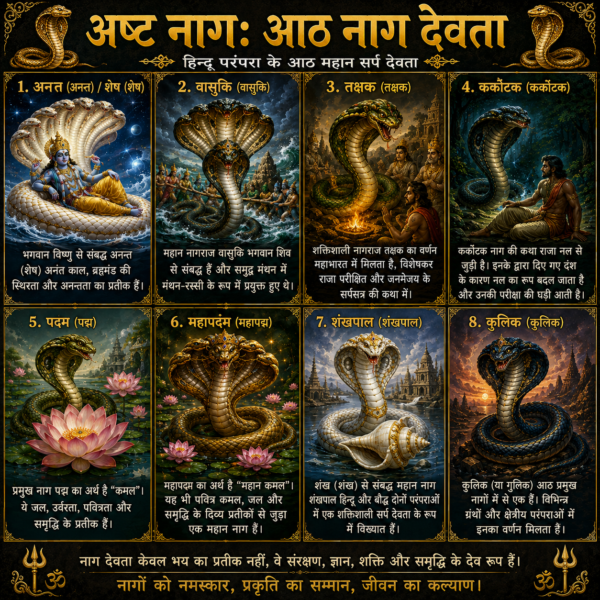
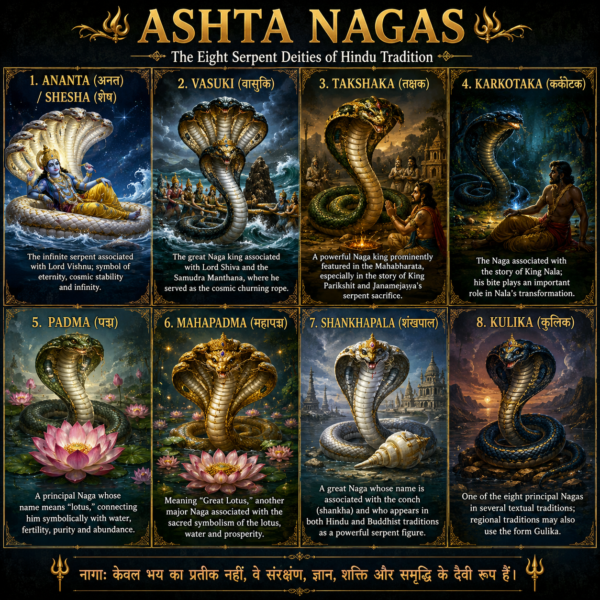
- Ananta (अनन्त) / Shesha (शेष) — The infinite serpent associated with Lord Vishnu; symbol of eternity, cosmic stability and infinity.
- Vasuki (वासुकि) — The great Naga king associated with Lord Shiva and the Samudra Manthana, where he served as the cosmic churning rope.
- Takshaka (तक्षक) — A powerful Naga king prominently featured in the Mahabharata, especially in the story of King Parikshit and Janamejaya’s serpent sacrifice.
- Karkotaka (कर्कोटक) — The Naga associated with the story of King Nala; his bite plays an important role in Nala’s transformation.
- Padma (पद्म) — A principal Naga whose name means “lotus,” connecting him symbolically with water, fertility, purity and abundance.
- Mahapadma (महापद्म) — Meaning “Great Lotus,” another major Naga associated with the sacred symbolism of the lotus, water and prosperity.
- Shankhapala (शंखपाल) — A great Naga whose name is associated with the conch (shankha) and who appears in both Hindu and Buddhist traditions as a powerful serpent figure.
- Kulika (कुलिक) — One of the eight principal Nagas in several textual traditions; regional traditions may also use the form Gulika.
Ashta Nagas: The Eight Serpent Deities of Hindu Tradition
The Ashta Nagas, literally meaning the “Eight Nagas” or “Eight Great Serpents,” occupy a fascinating and deeply symbolic place in the religious imagination of South Asia. In Hindu traditions, the Naga is far more than an ordinary snake. Nagas are supernatural serpent beings associated with water, fertility, the earth, hidden realms, protection, spiritual power and the mysterious forces that exist between the human and divine worlds. Among the countless serpent beings mentioned in Indian mythology, a group of eight came to be especially prominent in various scriptural, ritual and regional traditions. Their names are generally given as Ananta or Shesha, Vasuki, Takshaka, Karkotaka, Padma, Mahapadma, Shankhapala and Kulika, although the exact names and order can vary from one textual and regional tradition to another. The Agni Purana, for example, identifies Shesha, Vasuki, Taksha, Karkotaka, Padma, Mahapadma, Shankhapala and Kulika as the eight chief serpents.
The word “Naga” itself deserves attention because translating it simply as “snake” can obscure much of its religious meaning. In Sanskrit literature, Nagas are often imagined as powerful semi-divine beings capable of assuming serpent or human forms. They inhabit a supernatural realm associated particularly with Patala and subterranean waters, but they are not merely creatures of an underworld. They can be guardians, kings, devotees, protectors and dangerous supernatural powers. The Mahabharata and Puranic literature contain numerous stories about Nagas, while later regional traditions developed elaborate forms of Naga worship. Consequently, the Ashta Nagas should not be understood as eight ordinary snakes elevated into gods; rather, they represent eight particularly important manifestations within a much larger sacred universe of serpent beings.
Among the eight, Ananta, also called Shesha or Adishesha, is perhaps the most cosmically significant. The name Ananta means “endless” or “infinite,” and this meaning is central to his symbolism. In Vaishnava imagery, Vishnu is frequently depicted reclining upon the coils of Shesha in the cosmic ocean. The serpent therefore becomes an extraordinary symbol of eternity, continuity and the foundation underlying creation. Shesha is not simply an animal associated with Vishnu; he represents the cosmic principle of endlessness upon which the divine order rests. The association also explains why serpent imagery in Hinduism can simultaneously evoke danger and profound stability: the serpent can be a creature of the earth while also symbolizing an immense cosmic force. Krishna’s declaration in the Bhagavad Gita, “Among the Nagas I am Ananta,” further demonstrates the elevated status given to this serpent within Hindu theological symbolism.
Vasuki is another exceptionally important Naga and is strongly associated with Shiva as well as with one of the greatest episodes of Hindu cosmology, the Samudra Manthana, or churning of the ocean. In the famous myth, the gods and asuras use Vasuki as the cosmic rope wrapped around Mount Mandara in their attempt to churn the primordial ocean and obtain the nectar of immortality. Vasuki therefore becomes an active participant in the reordering of the cosmos rather than a passive supernatural figure. In Shaiva iconography, the serpent around Shiva’s neck is traditionally identified as Vasuki, reinforcing his association with fearlessness, divine power and mastery over forces that ordinary beings would fear.
Takshaka occupies a very different place in Hindu mythology because his importance is strongly connected with the Mahabharata. He is one of the most powerful Naga kings and is central to the story of King Parikshit. According to the epic tradition, Takshaka’s bite causes the death of Parikshit, an event that eventually leads to the great serpent sacrifice, the Sarpa Satra, performed by Parikshit’s son Janamejaya. The episode is significant because it transforms the Naga from a simple mythological creature into a participant in questions of vengeance, kingship, destiny and the consequences of violence. Takshaka’s story also demonstrates that the Nagas in Indian mythology are not uniformly benevolent or malevolent. They possess their own societies, loyalties and conflicts, and their interactions with humans can involve both protection and destruction.
Karkotaka, another member of the Ashta Naga tradition, is particularly associated with the mythology surrounding King Nala. His story appears in the Mahabharata’s Nala-Damayanti narrative and contributes to one of the epic’s most complex explorations of disguise, suffering, destiny and transformation. Karkotaka’s bite changes Nala’s appearance, and although the episode initially appears destructive, it ultimately becomes part of Nala’s eventual restoration. This recurring pattern is important in understanding serpent symbolism in Indian mythology: poison does not always represent only death. The same force that destroys can also transform, conceal, purify or prepare a person for renewal. The serpent’s ability to shed its skin naturally lends itself to such ideas of transformation and rebirth.
Padma and Mahapadma represent another dimension of the Naga imagination. Their names are associated with the lotus, one of the most important symbols in Indian religious thought. Padma means “lotus,” while Mahapadma means “great lotus.” The lotus itself carries layers of symbolism involving purity, emergence, fertility and the ability to arise from muddy waters without being contaminated by them. When such names are associated with serpent beings, they demonstrate how Naga symbolism extends beyond fear and poison into the domains of water, fertility, abundance and regeneration. The Agni Purana specifically includes Padma and Mahapadma among the eight chief serpents, confirming that their inclusion is not merely a later regional development.
Shankhapala, whose name is connected with the conch, is another member of the eightfold group. The conch is a major sacred symbol in Hinduism and is associated particularly with Vishnu, ritual sound and auspiciousness. Shankhapala is also prominent in Buddhist traditions, where he appears among lists of great Naga kings. This is an important reminder that Naga mythology cannot be confined to Hinduism alone. Serpent kings and serpent spirits became part of the religious imagination of Buddhism and other South Asian and Asian traditions, where they could function as guardians of sacred places, protectors of teachings and supernatural beings connected with water and the natural world. Tibetan Buddhist sources, for example, preserve an eightfold list containing Vasuki, Padma, Karkotaka, Takshaka, Mahapadma, Shankhapala, Kulika and Shesha.
Kulika, sometimes written as Kulika Naga and in certain regional traditions associated with Gulika, completes the commonly encountered Hindu list. The difference between Kulika and Gulika is one reason why readers may encounter apparently different versions of the Ashta Naga names. Likewise, regional traditions may alter spellings and pronunciations, producing forms such as Ananthan, Sankhapalan, Takshakan, Mahapatman, Patman, Karkodakan and Gulikan. These variations should not automatically be interpreted as contradictions. Hindu religious traditions have historically developed through the interaction of Sanskrit scriptures, regional languages, temple traditions, oral narratives and ritual practices. As a result, a single sacred group can have different forms in different parts of India.
One of the most important living centers of Ashta Naga worship is Kerala, where serpent worship is woven into the religious and cultural landscape through sacred groves known as kavu or sarpakkavu. These spaces traditionally preserve serpent shrines beneath trees and within protected natural environments. The relationship between serpent worship and sacred groves is particularly significant because it creates a religious framework in which the protection of the serpent deity and the protection of the natural environment become closely connected. The Kerala tradition recognizes the Ashtanagas as guardians associated with different directions and gives them particular symbolic attributes. Sources describing Kerala’s serpent iconography identify Anantha, Vasuki, Shankhapala, Gulika, Takshaka, Mahapadma and Karkotaka among the principal figures, with regional traditions providing variations in the exact classification and symbolism.
The ritual tradition of Kerala makes the Ashta Nagas especially interesting because the eight serpents are not simply remembered through stories; they are invoked through elaborate forms of sacred art, music and worship. The Pulluvan communities of Kerala have historically performed serpent rituals accompanied by distinctive songs and instruments, while serpent worship can involve the creation of intricate floor designs known as kalam. Ashta Naga Kalam represents the eight serpent deities through sacred visual patterns, while Pulluvan Pattu invokes and praises the serpent gods. The Smithsonian’s documentation of Pulluvan Pattu describes these songs as part of a ritual tradition in which serpent deities are regarded as protectors of the land.
The concept of the eight directions adds another important dimension to Ashta Naga symbolism. In some Kerala traditions, the eight principal serpent deities are connected with the eight directional divisions of sacred space. Anantha, Vasuki, Shankhapala, Gulika, Takshaka, Mahapadma and Karkotaka are assigned particular directions and symbolic attributes, while ritual arrangements create a sacred geography in which the serpent deities collectively surround and protect the ritual space. This interpretation helps explain why Ashta Naga worship can be represented through geometric floor paintings and carefully ordered ritual designs. The eight serpents are not merely a list of mythological personalities; together they form a protective sacred structure surrounding human life and the natural world.
The ecological dimension of Naga worship is particularly striking in Kerala. Sacred serpent groves historically functioned as protected patches of vegetation where trees were preserved because the place was believed to belong to the Nagas. The religious prohibition against disturbing such places could therefore indirectly protect biodiversity, water sources and old vegetation. Modern interpretations sometimes describe serpent worship primarily as superstition, but the historical institution of the sacred grove reveals a more complicated picture. Religious belief, landscape management, community identity and ecological preservation could operate simultaneously. In this sense, the Naga became a guardian not only of an imagined supernatural realm but also of a physical piece of land. The decline of traditional sacred groves is consequently viewed by cultural observers as both a religious and ecological loss.
Ashta Naga worship is also closely connected in many regional traditions with ideas of fertility, childbirth, prosperity and the removal of perceived obstacles associated with serpent deities. Rituals may be performed for family welfare, agricultural prosperity or the appeasement of Nagas. In Kerala, special rituals such as Ashta Naga Pooja and Sarpabali are associated with the serpent cult. At the Mannarasala Sree Nagaraja Temple, for example, an Ashta Naga Pooja specifically invokes Ananthan, Vasuki, Sankapalan, Takshakan, Mahapatman, Patman, Karkotakan and Gulikan. The temple tradition also connects serpent worship with rituals intended to address perceived astrological difficulties. Such practices belong to the religious world of devotees and should be distinguished from scientifically established medical or astrological claims.
The association between Nagas and Rahu and Ketu has also become prominent in later Hindu astrological practice. Serpent symbolism is often used to interpret particular forms of perceived planetary affliction, commonly described through concepts such as Naga Dosha or Kala Sarpa Yoga. The ritual response may involve worship of serpent deities, offerings, mantras and temple ceremonies. It is important, however, to distinguish between the historical and theological significance of these rituals and claims about their objective effects. The religious meaning of a ritual can be studied as part of India’s cultural and spiritual history without treating every traditional belief about health, fertility or astrology as an empirically established fact. This distinction allows the subject to be approached respectfully while maintaining intellectual clarity.
The deeper symbolism of the Ashta Nagas emerges when the individual figures are viewed together rather than separately. Shesha represents infinity and cosmic continuity; Vasuki represents participation in the cosmic struggle that produces immortality; Takshaka embodies the dangerous and unpredictable dimensions of Naga power; Karkotaka is associated with transformation through adversity; Padma and Mahapadma evoke lotus symbolism, water and abundance; Shankhapala connects serpent power with sacred protection and auspicious symbolism; and Kulika completes the eightfold configuration of powerful serpent beings. These associations are not rigid universal doctrines, because different texts and regions assign different characteristics to the Nagas, but collectively they reveal the extraordinary range of meanings that the serpent acquired in Indian religious thought.
There is also a fascinating philosophical paradox at the heart of Naga symbolism. The snake is feared because it possesses venom, moves silently and can strike without warning. Yet the same snake becomes an emblem of divine protection, fertility, immortality and cosmic stability. Shesha supports Vishnu, Vasuki participates in the churning of the cosmic ocean, and Naga guardians protect sacred places. The serpent therefore represents a power that cannot simply be classified as good or evil. It is dangerous when approached without respect, but protective when properly integrated into cosmic and ritual order. This ambivalence is one reason serpent imagery has remained so powerful throughout the religious traditions of India.
The idea of the eight Nagas also reflects the broader Indian tendency to organize cosmic forces through symbolic numbers and directional systems. Eight directions, eight guardians, eightfold sacred patterns and eight principal serpent deities create a conceptual structure in which the universe becomes ordered and protected. The Ashta Naga is consequently more than a collection of eight names. It is a way of imagining the relationship between earth, water, fertility, danger, protection and cosmic order. In Kerala’s ritual traditions, this conceptual structure becomes visible through sacred diagrams, songs, ritual movements and serpent groves. Research on the Ashta Naga Kalam tradition describes it as an elaborate combination of floor art, song, musical performance, ritual purification and invocation of the serpent deities.
The existence of multiple lists of eight Nagas is itself an important feature of the tradition. One source may list Ananta, Vasuki, Takshaka, Karkotaka, Shankha, Padma, Mahapadma and Gulika, while another may give Kulika instead of Gulika or use forms such as Shankhapala rather than Shankha. The Agni Purana provides yet another textual formulation, naming Shesha, Vasuki, Taksha, Karkotaka, Padma, Mahapadma, Shankhapala and Kulika. Kerala temple traditions can preserve still another set of names and pronunciations. Rather than searching for one universally authoritative list and dismissing every alternative as incorrect, it is more historically accurate to recognize that the Ashta Naga tradition has developed through multiple textual and regional streams.
This fluidity is characteristic of Hindu mythology more generally. Hindu sacred traditions did not develop from a single centralized institution that established one universally binding mythology. Epic narratives, Puranas, temple traditions, local legends, ritual manuals, oral cultures and regional devotional practices continuously interacted with one another. Consequently, figures such as the Nagas can change in emphasis according to place and tradition while retaining a recognizable identity. The Ashta Nagas of a Kerala sacred grove, the eight chief serpents of a Puranic classification and the eight great Naga kings of Tibetan Buddhism may overlap substantially while existing within different religious contexts. The variations therefore tell us something important about the living nature of the tradition itself.
The Ashta Nagas should ultimately be understood as part of a much larger Indian philosophy of the relationship between humans and the natural world. Water, rivers, underground spaces, trees, fertility and agricultural abundance have repeatedly been connected with serpent beings. The serpent lives close to the earth and often near water, disappears into holes and emerges unexpectedly, sheds its skin and possesses venom capable of killing. These characteristics made it an extraordinarily powerful symbol through which ancient communities could express ideas about death and renewal, hidden knowledge and danger, fertility and destruction, protection and fear. Religious imagination transformed these natural characteristics into a sophisticated mythology of supernatural serpent kings and guardians.
The enduring significance of the Ashta Nagas therefore lies not merely in memorizing the names of eight mythological serpents. Their stories preserve an entire worldview in which the visible and invisible worlds are deeply interconnected. Ananta expresses infinity, Vasuki participates in cosmic creation, Takshaka carries the force of destiny and vengeance, Karkotaka embodies transformation, Padma and Mahapadma connect serpent symbolism with the lotus and abundance, Shankhapala represents guardianship and sacred protection, and Kulika belongs to the wider family of powerful Naga beings. Together they demonstrate why the serpent became one of the most enduring religious symbols in the Indian subcontinent.
The Ashta Nagas remain particularly important because their worship survives not only in ancient texts but also in living ritual traditions. In Kerala, serpent groves, temple ceremonies, sacred drawings and Pulluvan songs continue to preserve forms of Naga devotion. The Ashta Naga Pooja at temples such as Mannarasala demonstrates how the eight serpent deities remain embedded in contemporary devotional practice. At the same time, the survival of serpent groves shows that the tradition has consequences beyond mythology: for centuries, sacred beliefs helped communities preserve particular landscapes as places inhabited and protected by divine serpent beings.
Ultimately, the Ashta Nagas represent one of the most remarkable examples of how Indian religious culture transformed an animal encountered in everyday life into a multidimensional sacred symbol. They are simultaneously serpents and divine beings, inhabitants of subterranean realms and guardians of the earth, dangerous powers and protectors, symbols of death and emblems of renewal. Their mythology stretches from the cosmic couch of Vishnu and the churning of the ocean to the forests and sacred groves of Kerala. Their presence across Hindu, Buddhist and regional traditions demonstrates the remarkable cultural reach of the Naga idea. To understand the Ashta Nagas, therefore, is not simply to study eight serpent deities; it is to enter a larger world in which nature, mythology, cosmology, ritual, sacred geography and human imagination are woven together into a single symbolic universe.
Ashta Nagas: The Eight Serpent Deities of Hindu Tradition