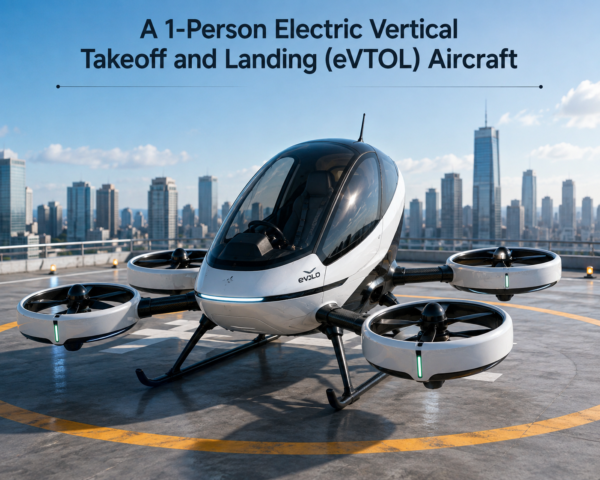
A 1-Person Electric Vertical Takeoff and Landing (eVTOL) Aircraft
The Rise of the Personal Flying Machine
For more than a century, the dream of personal flight has occupied a strange space between science fiction and engineering reality. The automobile gave individuals unprecedented freedom on the ground, while the airplane made long-distance travel dramatically faster, but neither solved the fundamental problem of moving a single person directly from one point to another without roads, traffic, runways, or large airports. A new category of aircraft is now attempting to close that gap: the one-person electric vertical takeoff and landing aircraft, commonly described as a personal eVTOL. Unlike conventional airplanes, these machines can rise vertically from a compact area, hover, maneuver at low speed, and land vertically. Unlike traditional helicopters, they can use multiple electric motors and distributed propulsion instead of a single combustion engine and complex mechanical drivetrain. The result is an entirely different vision of personal aviation: not a small airplane adapted for one person, but a compact electric flying machine designed around the individual pilot.
The basic idea behind a one-person eVTOL is deceptively simple. A pilot sits inside or above a lightweight structural frame while several electric motors drive propellers or rotors positioned around the aircraft. During takeoff, the rotors generate upward thrust until the aircraft rises from the ground. Once airborne, the pilot can control movement through a joystick or similar flight-control interface. Some designs remain fundamentally multicopters, using the thrust of their rotors to control movement in every direction, while others incorporate wings so that the aircraft can transition from vertical flight into more efficient forward flight. The distinction is important because hovering is energetically expensive. A vehicle that can use aerodynamic lift from wings during cruise can potentially travel farther than one that must continuously support itself with rotor thrust. The U.S. Federal Aviation Administration describes powered-lift aircraft as machines capable of vertical takeoff and landing and low-speed flight, with some designs subsequently flying more like airplanes during cruise.
One of the most compelling aspects of the one-person configuration is that it reduces the fundamental weight problem facing electric aviation. Every kilogram carried into the sky requires additional lift, and additional lift requires additional energy. A conventional air taxi designed for several passengers must carry a cabin, seats, doors, environmental systems, luggage, extensive structural components, and large battery systems while still maintaining useful range and safety margins. A single-seat aircraft can eliminate much of that mass. Its cabin can be replaced by a lightweight cockpit or open seating arrangement, and the vehicle can be designed around one human rather than a group of passengers. This does not eliminate the energy challenge, but it creates an engineering environment in which today’s batteries become considerably more practical.
The Jetson ONE provides one of the clearest real-world demonstrations of this concept. Developed by Jetson, the aircraft is a single-seat electric personal aerial vehicle using eight electric motors and fixed-pitch propellers. The manufacturer lists a mass of approximately 115 kilograms including batteries, a maximum pilot weight of 95 kilograms, an electronically limited top speed of approximately 102 km/h, and an approximate flight time of 20 minutes. Its design incorporates an aluminum space-frame structure, redundant electric propulsion, a ballistic parachute, automatic landing assistance and a four-axis joystick control system. Jetson currently states that it is taking orders for 2028.
The importance of such a machine is not necessarily its current 20-minute flight time or 102 km/h speed. Its greater significance is that it demonstrates how advances in electric propulsion, lightweight materials, electronic flight controls and battery technology are converging to make personal vertical flight technically achievable. The aircraft does not need to compete with a commercial airliner. It does not need to carry ten passengers hundreds of kilometers. Its purpose can be much more modest: give one person the ability to take off vertically, fly a relatively short distance and land without requiring a conventional runway.
Another important predecessor in this field is the BlackFly, developed by Opener. The BlackFly represents a different design philosophy from the open-frame multicopter concept. It uses a lightweight fixed-wing configuration combined with distributed electric propulsion, allowing the aircraft to obtain aerodynamic lift from its wings during forward flight. Available technical data describes it as a single-seat aircraft with eight propulsors and a carbon-fiber-oriented lightweight structure. Earlier versions were designed around relatively short-distance personal transportation rather than intercity aviation. The existence of both concepts—multirotor personal aircraft and winged personal eVTOLs—illustrates that there is no single formula for the future of personal electric flight.
The battery, however, remains the heart of the problem. Electric motors are extraordinarily attractive for aircraft because they are mechanically simple, controllable and capable of delivering high power with relatively few moving parts. Batteries are much less forgiving. A battery must provide sufficient energy for the entire flight while also providing the extremely high power required during vertical takeoff, climbing and emergency maneuvering. NASA research has repeatedly identified energy storage as one of the major barriers to practical electric aviation. NASA has noted that eVTOL applications impose demanding energy and power requirements, with aerospace battery systems requiring both high performance and rigorous safety characteristics.
This creates a fundamental difference between an electric car and an electric aircraft. A car can tolerate a heavy battery because the wheels support most of the vehicle’s weight. An aircraft cannot. The battery must be carried by the aircraft while the aircraft is simultaneously using energy to keep itself airborne. Every kilogram added to increase range can therefore require additional propulsion capability, which in turn adds weight and may require an even larger battery. This creates a difficult design loop. Aviation engineers call this one of the central challenges of electric flight, and it explains why an electric car capable of traveling hundreds of kilometers cannot simply be translated into an aircraft with the same range.
Vertical flight makes the problem even more demanding. During takeoff, the aircraft cannot initially rely on wings for lift because it has essentially zero forward airspeed. Its propulsion system must generate enough thrust to lift the complete aircraft and pilot directly upward. This requires a large amount of power. Once the aircraft transitions into forward flight, aerodynamic lift can reduce the amount of thrust required in winged configurations. Research into eVTOL trajectory optimization therefore focuses heavily on managing the transition between hover, climb, cruise and landing so that the aircraft does not waste more energy than necessary. Studies of electric VTOL flight planning have shown that intelligent trajectory selection can substantially reduce energy consumption compared with inefficient flight paths.
This is why the architecture of a one-person eVTOL matters so much. A pure multicopter is mechanically straightforward and can be extremely maneuverable, but it must continually use rotor thrust to remain airborne. A winged eVTOL can potentially achieve much greater cruise efficiency, but its aerodynamic and control systems become more complicated. Tilt-rotor and tilt-wing concepts introduce another possibility by changing the orientation of the propulsion system between vertical and forward flight. The ideal configuration depends on the intended mission. A recreational aircraft designed for short local flights may prioritize simplicity and vertical maneuverability, whereas a personal commuter aircraft intended to travel tens or hundreds of kilometers would benefit much more from efficient wing-borne cruise.
The use of multiple electric motors also creates a major safety advantage compared with the single-engine architecture of many small conventional aircraft. A traditional aircraft may depend heavily on one engine or a small number of mechanically coupled propulsion components. A distributed electric aircraft can have several independent motors. If one motor fails, the flight-control computer can potentially compensate by adjusting thrust from the remaining motors. Jetson, for example, explicitly states that its aircraft is designed to remain controllable following the loss of one motor and uses redundant battery propulsion. This is one of the most important concepts behind electric distributed propulsion: instead of relying on one large propulsion system, the aircraft can distribute the job across multiple smaller systems.
Redundancy, however, should not be confused with invulnerability. An aircraft with eight motors can still suffer a catastrophic failure involving batteries, flight controls, structural components, sensors, software or multiple propulsion units. The most difficult engineering problem is therefore not simply making the aircraft fly; it is ensuring that predictable failures do not turn into catastrophic accidents. This requires redundant power supplies, independent control pathways, fault detection, emergency landing systems, robust software, thermal management and carefully designed structural protection for the occupant.
The ballistic parachute is particularly interesting in this context. A conventional airplane normally depends on aerodynamic glide performance and pilot skill to deal with an engine failure. A small multicopter has much less ability to glide because its rotors do not necessarily provide useful aerodynamic lift after power is lost. A ballistic parachute provides another layer of protection by deploying a parachute rapidly enough to slow the aircraft and occupant. Jetson lists a ballistic parachute as one of the aircraft’s safety systems. The technology does not make an accident impossible, but it changes the emergency philosophy from “the pilot must always find a place to land” toward “the aircraft should have an independent means of reducing descent speed when normal flight becomes impossible.”
Automatic flight assistance is likely to become equally important. A personal eVTOL cannot realistically expect every owner to have the experience of a helicopter pilot. The aircraft therefore has an opportunity to use computers to stabilize flight, manage propulsion and provide emergency assistance. Sensors such as inertial measurement units, GPS, radar or other ranging systems can provide the flight computer with information about altitude, position, attitude and nearby terrain. Jetson, for example, describes radar-assisted automatic landing functionality and hands-free hover and emergency functions. As these systems mature, the human pilot may increasingly become a supervisor rather than someone manually controlling every aspect of flight.
That development raises a profound question: should a personal eVTOL really be considered a small aircraft, or should it eventually become something closer to an autonomous aerial vehicle for humans? The answer may change over time. Early personal eVTOLs will probably require active pilot participation because regulators and the public will demand human accountability. But increasingly sophisticated automation could eventually make vertical flight easier for ordinary people. A future personal aircraft might perform automated preflight checks, monitor battery health, calculate safe routes, detect obstacles, maintain stable hover, manage landing approaches and automatically respond to certain emergencies.
Regulation will determine how quickly this vision becomes reality. Aviation is fundamentally different from driving because a malfunctioning car generally remains on the ground, while an aircraft failure can affect the pilot and people below. Governments therefore have to establish standards for aircraft design, pilot qualification, operating altitude, visibility, airspace integration, maintenance, noise, emergency procedures and many other factors. In the United States, the FAA finalized a powered-lift regulatory framework in October 2024 covering pilot certification, operating rules and integration of powered-lift aircraft into the national airspace system. The agency specifically recognized powered lift as a new category with characteristics of both airplanes and helicopters.
The regulatory picture becomes especially interesting for very small one-person aircraft. In the United States, Part 103 provides a framework for certain single-occupant ultralight vehicles used for recreation or sport. Among other conditions, a powered ultralight must remain below specified empty-weight, speed and other limits. Some personal eVTOL developers have designed their aircraft with this regulatory environment in mind. But this should not be interpreted as meaning that every electric flying machine is automatically an ultralight or can be operated without a license. Classification depends on the aircraft and the jurisdiction, and regulations outside the United States can be very different.
The regulatory challenge is even greater when personal eVTOLs move from recreational flying into everyday transportation. An aircraft used for commuting between a private property and a workplace is fundamentally different from an aircraft operating as part of a commercial air-taxi network. Once hundreds or thousands of vehicles occupy the same low-altitude airspace, authorities must manage traffic separation, communications, emergency routes, weather restrictions and landing infrastructure. Research into eVTOL safety has identified airspace integration, collision avoidance, energy management, certification, automation and infrastructure as major areas requiring careful development.
Infrastructure could ultimately determine whether personal eVTOLs become a genuine transportation revolution or remain expensive recreational machines. A helicopter can theoretically land in many locations, but an urban fleet of electric aircraft cannot simply land anywhere. Noise, rotor wash, safety zones, electrical infrastructure, emergency access and public acceptance all matter. Dedicated landing areas, charging facilities and maintenance stations may therefore become essential. Current developments in the broader eVTOL industry are already moving beyond the aircraft itself toward the electrical infrastructure needed to support future fleets.
Charging presents another challenge. A personal aircraft with a short flight time may be acceptable for recreational use, but it becomes much more valuable when it can be rapidly recharged or equipped with modular batteries. The economics of personal aviation will depend not merely on how far the aircraft can fly but on how quickly it can return to service. Battery swapping could become particularly attractive for commercial operations because it could reduce turnaround time, although swapping high-energy aviation batteries introduces its own engineering, logistics and safety challenges. Recent research into eVTOL charging infrastructure has emphasized that battery energy density, high power requirements, rapid energy replenishment and charging infrastructure are all interconnected constraints on commercialization.
The environmental argument for personal eVTOLs is attractive but requires nuance. Electric propulsion eliminates direct exhaust emissions during flight and can substantially reduce local air pollution compared with combustion-powered aircraft. Electric motors can also be quieter than conventional engines, although the propellers and rotors themselves still produce significant aerodynamic noise. The total environmental benefit depends on battery manufacturing, electricity generation, aircraft utilization, battery replacement and the amount of travel that the aircraft actually replaces. If a person uses an eVTOL instead of walking, cycling or public transportation for short journeys, the environmental equation is very different from using it to replace a helicopter or conventional private aircraft.
Noise may become one of the most important public-acceptance issues. The phrase “electric” can create the impression of silence, but an electric aircraft is not silent. Propellers moving large amounts of air inevitably create sound. However, electric propulsion offers engineers much greater control over rotor speed, blade geometry and distributed propulsion architecture. This could allow designers to optimize acoustic signatures in ways that are difficult with conventional engines. NASA and other research organizations have therefore treated noise reduction as an important component of advanced air mobility rather than assuming that electric propulsion automatically solves the problem.
There is also an intriguing social dimension to the one-person aircraft. Historically, private aviation has been expensive, technically demanding and geographically restricted. The personal eVTOL attempts to reverse some of those characteristics by making the aircraft smaller, electrically powered and potentially easier to operate. If production volumes rise and batteries become more capable, a personal eVTOL could eventually occupy a category somewhere between a high-end motorcycle, recreational aircraft and personal mobility device. It could be used for rural transportation, emergency access, recreation, inspection work, remote-area travel and short-distance commuting.
Rural and remote applications may actually arrive before mass urban commuting. In a city, the aircraft must deal with buildings, dense populations, complex airspace, noise restrictions and limited landing areas. In rural areas, many of those obstacles are reduced. A farmer, surveyor, emergency responder or remote-area worker may value vertical flight because it eliminates the need for roads or runways. A small electric aircraft could potentially cross difficult terrain, reach isolated locations or inspect large areas much more quickly than a ground vehicle.
Emergency response represents another potentially important application. A one-person eVTOL could theoretically provide rapid access to locations where roads are blocked, damaged or nonexistent. Search-and-rescue operations, disaster assessment, infrastructure inspection and emergency medical response could all benefit from compact vertical flight. The broader eVTOL sector is already considering applications extending beyond passenger transportation, including cargo, medical transportation and other specialized missions. The FAA itself identifies air ambulance and cargo operations among the potential applications of powered-lift aircraft.
The economics are perhaps the biggest unknown. Building an aircraft that flies is one problem; building one that ordinary people can afford is another. Aviation-grade batteries, redundant motors, flight computers, sensors, structural materials, parachutes, testing and certification all cost money. The aircraft must also be maintained according to appropriate safety standards. Even if electric propulsion reduces fuel and mechanical maintenance costs, ownership will not necessarily become cheap. A personal eVTOL may initially resemble the early automobile or early private aircraft market, where ownership is limited to enthusiasts and wealthy early adopters before manufacturing scale and technological maturity gradually lower costs.
Mass production could change that equation dramatically. Electric propulsion has the potential to simplify manufacturing because multiple identical electric motors can replace some of the complicated mechanical systems used in conventional aircraft. Distributed propulsion can also allow standardized motor and controller modules to be manufactured at scale. Automated composite manufacturing, lightweight aluminum structures, advanced batteries and digital flight-control systems could further reduce production costs. But aviation certification imposes a level of quality control that cannot simply be bypassed in the pursuit of cheap manufacturing.
Battery technology is likely to be the single most important factor determining the future of the one-person eVTOL. Current lithium-ion systems have enabled short-duration personal electric flight, but greater energy density would directly translate into improved endurance, payload or safety margins. NASA has been researching next-generation batteries, including lithium-sulfur and solid-state concepts, precisely because future electric aviation requires greater energy density without compromising safety. NASA has described lithium-sulfur systems as potentially offering substantially higher theoretical gravimetric energy density than today’s commercial lithium-ion technology, although theoretical potential should not be confused with commercially available aviation batteries.
The next major transformation could therefore occur when battery technology improves enough that a small aircraft no longer has to choose between useful range and useful payload. Imagine a future one-person aircraft that can fly for an hour or more, recharge rapidly, carry the pilot and equipment, automatically navigate a pre-approved route and safely return to its departure point even after a subsystem failure. Such a vehicle would be far more significant than today’s short-duration recreational eVTOL. It would begin to resemble a genuine personal transportation platform.
Yet the most important breakthrough may not come from the battery alone. Advances in artificial intelligence, autonomous navigation, sensor fusion, lightweight materials, electric motors, power electronics and air-traffic management could collectively make the aircraft dramatically more capable. The aircraft of the future may be designed as an integrated digital system rather than as a traditional airframe with separate mechanical subsystems. Its flight computer could continuously optimize power consumption, monitor motor temperatures, evaluate battery condition, predict remaining flight time and select emergency landing options.
The idea of a personal eVTOL also changes our understanding of what a “vehicle” is. A car requires roads, a train requires tracks and an airplane generally requires airports. A vertical aircraft requires none of these in the same way. It creates a third dimension of mobility. Instead of moving through a fixed road network, a personal eVTOL could potentially travel directly between geographically separated points. In a mature system, a person might leave a home, rise vertically, travel across a valley or congested urban corridor and land near the destination without interacting with the road network at all.
But that freedom must be balanced against the rights and safety of everyone else. The sky above a city cannot become an uncontrolled extension of the road system. Thousands of independent aircraft would create a completely different risk environment from thousands of cars. The future of personal eVTOLs therefore depends not only on making aircraft safer but on making the entire airspace system intelligent enough to manage them. Automated traffic coordination, digital identification, geofencing, real-time weather information and highly reliable communication systems may become just as important as the aircraft itself.
There is also a psychological barrier. People have decades of experience trusting cars, trains and commercial airplanes, but relatively little experience seeing ordinary individuals fly electric aircraft around them. Public acceptance will depend heavily on demonstrated reliability. One dramatic accident involving a popular personal eVTOL could influence public opinion and regulation far more strongly than dozens of successful demonstrations. The industry therefore has an unusually difficult task: it must not merely prove that these aircraft can fly, but prove that they can fail safely.
In this respect, the one-person eVTOL may ultimately follow a different path from the futuristic “flying car” vision often portrayed in popular culture. Instead of replacing every automobile, it may first become a specialized tool. Enthusiasts may use it recreationally. Professionals may use it for inspection and surveying. Emergency services may use it for rapid access. Rural communities may use it for transportation. Over time, successful technology, falling prices and improving regulation could expand the market toward everyday personal transportation.
The greatest strength of the one-person eVTOL is also its greatest limitation: it is small. Its small size makes vertical flight more feasible, reduces the structural and energy burden, and allows highly distributed propulsion. But the same small size restricts battery capacity, payload, weather tolerance and range. A personal aircraft carrying one person may be able to accomplish short missions efficiently, but it cannot automatically become a replacement for a family automobile or commercial aircraft. Its real value lies in the specific missions where vertical access and direct travel are more important than carrying capacity.
Today, the Jetson ONE provides a particularly vivid example of where this technology stands. Its published specifications—approximately 20 minutes of flight time, a software-limited speed around 102 km/h, an eight-motor propulsion system, a 95-kilogram maximum pilot weight and multiple emergency features—show both the promise and the limitations of current personal electric flight. The aircraft is small enough to make the concept physically achievable, yet its relatively short endurance demonstrates just how demanding sustained electric flight remains.
The future one-person eVTOL will probably look considerably different from the earliest machines. It may have a more enclosed cockpit, improved weather protection, higher-energy batteries, quieter propulsion, advanced obstacle detection, greater automation and a wing optimized for efficient cruise. It may also become more modular, with interchangeable battery packs, software-defined flight systems and standardized maintenance components. Instead of being treated primarily as a novelty, it could eventually become a sophisticated personal aircraft category in its own right.
The most fascinating possibility is that personal eVTOLs may represent the beginning rather than the end of a much larger transition. The same technologies developed for a one-person electric aircraft—high-power batteries, lightweight structures, distributed propulsion, autonomous flight control and intelligent airspace management—can eventually scale into two-person aircraft, cargo vehicles, air taxis, emergency aircraft and regional transportation systems. The one-person machine is therefore more than a flying gadget. It is a compact laboratory for the technologies required to electrify aviation.
The dream of personal flight has existed since humans first looked upward and imagined leaving the ground. For decades, that dream was constrained by the weight of engines, the complexity of mechanical systems, the cost of aviation and the difficulty of vertical flight. Electric propulsion has begun to change those equations. A lightweight frame, a collection of small motors, sophisticated control software and a high-energy battery can now produce something that would have seemed almost impossible to an earlier generation: an individual sitting in a compact machine and rising vertically into the sky without a runway.
The one-person eVTOL is not yet a flying automobile for everyone, and it would be misleading to pretend that technological demonstrations have solved the challenges of certification, energy density, infrastructure, weather, affordability, airspace integration and public safety. The industry still has a long road ahead. But the significance of the technology lies precisely in the fact that the question has changed. We are no longer asking whether a human-sized electric vertical aircraft can exist. Machines such as the Jetson ONE and other personal eVTOL concepts demonstrate that it can. The far more difficult and fascinating question now is whether engineering, regulation, economics and public trust can develop quickly enough to transform that remarkable machine from an experimental personal aircraft into a practical new form of transportation.